The Best First Toys, Ranked by How Long They Stay Useful
Five toys that earn their floor space across years rather than weeks, chosen against what a baby can physically do at each stage.
- Writer, standards and the recall record
- Aug 11, 2026
- Updated Sep 4, 2026
- 13 min read
5 products compared
In this guide
The toy that gets used is almost never the toy that demos best. It is the one that still has a job eighteen months after it arrives, because a child has invented a third and fourth use for it that nobody printed on the box.
So these five are ranked on working life rather than on features, and every one of them is quiet. That is deliberate: the best-known research on this compared electronic toys with blocks and books and found that during play with the electronic ones, parents talked less and there were fewer conversational turns. The argument is in do developmental toys do anything, and it is the reason nothing here has a battery. Before any of these, the earliest months are usually spent with a teething toy more than anything else, since a mouth doing most of the exploring outranks hands doing most of the holding.
The picks
$9.99
Price checked Sep 4, 2026
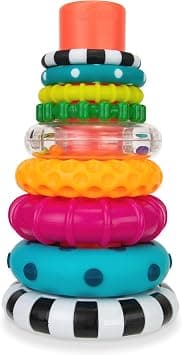
Sassy Stacks of Circles
A ring stacker is three toys in sequence. At six months the rings come off the post and go in the mouth. At nine they are objects to move between hands. Somewhere past a year they go back on the post in order, which is the thing it was sold for and the last of its three jobs to arrive. Ten dollars for eighteen months of use is the best value here.
We may earn a commission on this link. It never changes the ranking.
- From
- About 6 months, in the simplest way
- Peak use
- 9 to 18 months
- Power
- None
- Material
- Soft plastic
What works
- Usable from around six months in a different way at each stage, so it does not sit in a box waiting
- The rings are useful independently of the post, which doubles the ways it gets played with
- Soft and light enough to be mouthed safely at the stage when everything is
- The cheapest thing on this list by a wide margin
What to know
- The ordered stacking it is marketed for is the last capability to arrive, so early on it looks like it is not working
- Not a heirloom object, and it will look tired after two children
- Nothing about it is quiet in the sense of tidy, since the rings end up under furniture
$15.00
Price checked Sep 4, 2026
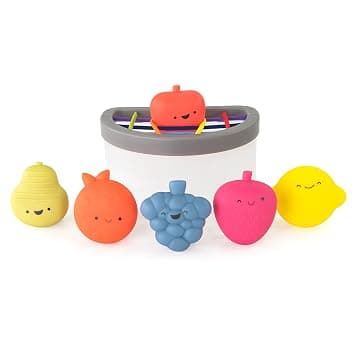
Sassy Fruit Fill N' Spill
Around nine months the dominant interest becomes putting objects into other objects and taking them out again, and it holds for months. This is that stage in a box. It is the single best-matched toy to a specific developmental window on this list.
We may earn a commission on this link. It never changes the ranking.
- From
- About 8 to 9 months
- Peak use
- 9 to 18 months
- Power
- None
- Pieces
- Soft fruit shapes plus a container
What works
- Lands exactly on the fill-and-empty interest that arrives with the pincer grip
- The pieces work on their own once the container is elsewhere, which is most of the time
- Light enough to be carried around by a child who has just learned to carry things
- Fifteen dollars
What to know
- Almost useless before about eight months, so it is a toy to buy at the stage rather than ahead of it
- Small pieces mean it needs putting away properly in a house with an older sibling
- The container is the part most likely to be lost first
$32.30
Price checked Sep 4, 2026
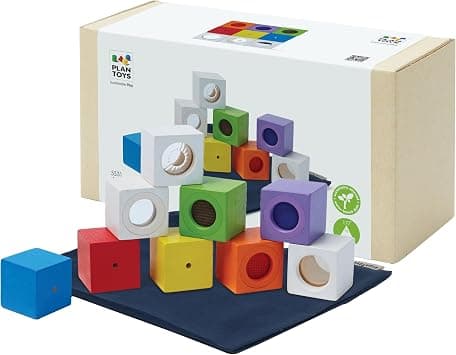
PlanToys Sensory Activity Blocks
Nine rubberwood blocks in three groups of three: three that do something to look at, three that make a sound, three with a surface that feels different from the others. That is the whole toy, and it is why it lasts. A one-year-old turns them over and shakes them, a two-year-old sorts and stacks them, and the set never stops being nine blocks that can be built with. The reason it is here rather than a wooden stacking game is the age grading, which PlanToys puts at twelve months and up on its own product page. Most of the wooden sets a parent meets in this aisle are graded three years and up for small parts, which puts them a year or two beyond the child this list is about.
We may earn a commission on this link. It never changes the ranking.
- From
- 12 months, per the manufacturer's own grading
- Peak use
- 1 to 3 years
- Power
- None
- Pieces
- 9 blocks: 3 visual, 3 auditory, 3 tactile
What works
- Graded 12 months and up by the manufacturer, so it works in the year it is bought rather than two years later
- Three kinds of input, visual, auditory and tactile, in one set instead of three separate toys
- Rubberwood with water-based dyes, so it survives being chewed, dropped and stood on
- Storage bag included, which is most of what keeps a nine-piece set from becoming a six-piece set
What to know
- Two to three times the price of the plastic picks above it, for nine blocks
- Not a building set: nine blocks is a set to explore, and the unit blocks below are the answer if construction is the point
- The auditory blocks are the loudest thing on this list, which is a real consideration in a small flat
$17.99
Price checked Sep 4, 2026
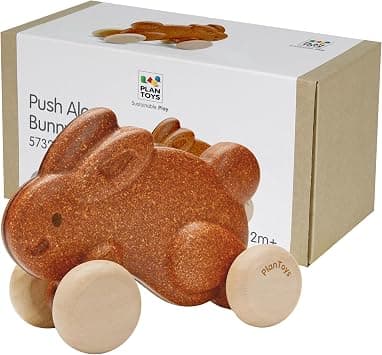
PlanToys Push Along Bunny
The right answer to the impulse that sells baby walkers. A child pushes this on their own feet, at the speed their own balance allows, which is the thing a wheeled seat takes away from them. Buy this instead of a walker, for reasons set out in the play equipment guide.
We may earn a commission on this link. It never changes the ranking.
- From
- Once pulling to stand, usually around 9 to 12 months
- Peak use
- 10 to 24 months
- Power
- None
- Material
- Wood
What works
- Supports walking practice at the child's own pace rather than at a wheel's pace
- Nothing to strap a child into, so none of the walker hazards apply
- Becomes a pull-along and then a small vehicle for other toys
- Under twenty dollars
What to know
- Only becomes interesting once the child is already pulling to stand, so it waits in a corner first
- A push toy on carpet is harder work than on a hard floor
- Not a substitute for supervision near stairs, which nothing is
For more push-walker options at other price points, see the best push walkers.
$89.99
Price checked Sep 4, 2026
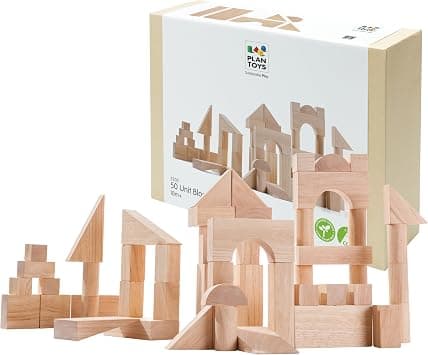
PlanToys 50 Unit Blocks
The most expensive thing here and the one with the longest life by a decade. A proper unit block set is knocked over at one, stacked at two, built into towers at three and used as roads, walls and furniture for small figures for years after. If you buy one costly toy in the first two years, this is the defensible choice.
We may earn a commission on this link. It never changes the ranking.
- From
- About 12 months for handling, 2 years for building
- Peak use
- 2 to 6 years
- Power
- None
- Pieces
- 50 wooden unit blocks
What works
- Genuinely open-ended, which is why unit blocks have been in nursery classrooms for a century
- Proportioned so pieces relate to each other, which is what makes real building possible later
- Wood, so it survives two or three children and can be passed on
- Nothing to break, update, charge or replace
What to know
- Ninety dollars, which is a lot to spend on something a one-year-old will mostly knock over
- Heavy as a set, and it needs somewhere to live
- The payoff is at two to five years rather than in the first year, so it is bought early and enjoyed late
The comparison, in one table
| Toy | Price | Useful from | Peak years | Battery |
|---|---|---|---|---|
| Sassy Stacks of Circles | $9.99 | ~6 months | 9 to 18 months | None |
| Sassy Fruit Fill N' Spill | $15.00 | ~8 months | 9 to 18 months | None |
| PlanToys Sensory Activity Blocks | $32.30 | 12 months | 1 to 3 years | None |
| PlanToys Push Along Bunny | $17.99 | Pulling to stand | 10 to 24 months | None |
| PlanToys 50 Unit Blocks | $89.99 | ~12 months | 2 to 6 years | None |
Who each one is wrong for
The ring stacker is wrong for anyone expecting a six-month-old to stack anything. That capability is a year away, and the toy is doing something else in the meantime.
The Fill N' Spill is wrong before about eight months, when it is a bag of shapes and a bowl.
The Sensory Activity Blocks are wrong if you want a building set. Fifty unit blocks is a building set. This is nine blocks and an invitation to notice what each one does.
The Push Along Bunny is wrong for a child who is not yet pulling to stand, which is the temptation it shares with a walker and the reason people buy walkers too early.
The 50 Unit Blocks are wrong as a first-birthday present in a small flat, where ninety dollars of wooden blocks will spend a year in a box before they become interesting.
What is deliberately not here
Anything with a battery. Not for peace, though that is a benefit. Because a toy that names the colours has taken the narrating job, and that is the job you want.
Anything marketed as educational or STEM. Neither term is regulated or corresponds to any test, which is covered in do developmental toys do anything. The age grading beside them is a real safety classification and is worth following exactly.
A play gym, which is genuinely the best first-year purchase and belongs in a different comparison, alongside the activity centers and the one product the AAP has asked to have banned. That is play gyms and activity centers.
A crib mobile or crib gym, because neither is a toy a baby plays with in the hands, and both come with a removal date rather than an age grade. The rule and where it came from are in when to take down a crib mobile.
Stacking cups, which would otherwise top this list on value. They are a commodity sold by everyone at every price and there is no pick worth naming. Buy any set.
Bath toys, because a squeeze toy that seals bath water inside is a problem of its own, and the four that open, drain or go in the dishwasher instead are in bath toys that don't trap mold.
When to buy each one
Buying ahead of the stage is the standard way to waste money here, and toys by development stage sets out what a baby can actually do month by month. The short version: the ring stacker around six months, the Fill N' Spill around eight, the sensory blocks and the unit blocks around a year, and the push toy the week the pulling-to-stand starts.
One trap is worth naming before anyone shops the wooden aisle. Plenty of wooden sets that photograph like toddler toys are graded three years and up, because their pieces are small enough to fail the small-parts test. PlanToys' own Stacking Logs, from the same maker as two of the picks above, is graded 3 years and up on the maker's product page, and it looks in a photograph exactly like something a one-year-old would be handed. That grading is a safety classification rather than a difficulty rating, so read the age on the box before the copy on the front of it. A set graded three and up is not a first-birthday present, and the year between the two is exactly the year this list is trying to cover.
Whether any pick here actually clears the choking-hazard standard, and where that standard's own limits are, is covered in choking hazards in toys. The two small-object hazards that test was never designed for, coin cells in light-up toys and strong magnets, have their own federal rules, set out in button batteries and magnets in toys.
None of these toys have a screen, which is deliberate. What the WHO and the AAP actually recommend about screen time before age two, and the lesser-known rule about how long a baby should sit in a stroller or high chair at a stretch, is in how much screen time is actually recommended before age 2.
Questions people actually ask
Are wooden toys better than plastic ones?
Not for development, and both meet the same federal safety standard. What matters is whether a toy is open-ended and whether it is quiet, and wooden toys are more often both. That is a correlation with how they tend to be designed rather than a property of the wood.
Is a ninety-dollar block set worth it for a baby?
Not for a baby, and that is the honest framing. A unit block set is bought in the first year and enjoyed from about two to six, which makes it good value per year and a strange first-birthday present in a small home. If money is tight this year, buy it next year.
Why is there no stacking cup set on the list?
Because there is no pick worth naming. Stacking cups are the best-value toy of the first year and they are a commodity sold by every brand at every price. Buy any set, and use them as containers before you use them as a stack.
What about a walker for a baby who wants to move?
The AAP recommends a ban on the manufacture and sale of mobile infant walkers. The push-along toy here does what a walker claims to do, on the child's own feet and at the speed their own balance allows, which is the whole difference.
How many toys should be out at once?
Fewer than most homes have out. A small selection swapped every couple of weeks produces longer and more sustained play than a full toy box, because a child facing thirty options tends to sample all thirty rather than settle into any one.
Sources
As an Amazon Associate we earn from qualifying purchases. We earn a commission on some links, at no extra cost to you. It never changes which products we recommend or the order they appear in. Full disclosure
Who wrote this
Writer, standards and the recall record
Dan Whitfield writes the standards side of BabyGearSearch: what a certification actually covers, what the CPSC recall database says about a brand, and what the one-star reviews agree on six months in. He is not a clinician and does not write as one. His job is to read the standard rather than the marketing page, quote the real number, and name the limit the packaging skipped.
More from DanThe standard
How this guide was built
- Manufacturer specification sheets and warranty terms, read in full rather than summarised from a listing.
- The federal safety standard the product is certified to, plus anything NHTSA, the AAP or the CPSC has published on it.
- Owner reports at volume, including the one-star reviews, which is where failure modes live.
- Every price checked against the live listing on the date printed beside it.