Toys by Development Stage: What a Baby Can Actually Do
Most first-year toys are bought months before they are usable. What a baby can grasp, track and manipulate at each stage, and what to buy when.
- Writer, standards and the recall record
- Jul 6, 2026
- Updated Aug 18, 2026
- 8 min read
In this guide
- Birth to about 3 months: looking, not holding
- About 3 to 6 months: reaching and mouthing
- About 6 to 9 months: sitting, transferring, banging
- About 9 to 12 months: pincer grip and containers
- 12 to 24 months: doing what the object is for
- The buying strategy that follows
- Reading the age label
- Where this sits
- Sources
The most common way to waste money on baby toys is to buy the right toy at the wrong time. A shape sorter bought at four months sits in a box for a year, and by the time it comes out the child has been given three more.
Physical capability arrives in a fairly predictable order, and it is what decides whether a toy is usable. Here is the sequence and what each stage can genuinely do with an object.
Every age below is a rough marker rather than a schedule. Babies vary widely and normally, and if you are worried about your own baby's development that is a conversation with a pediatrician rather than something to resolve against an article.
Birth to about 3 months: looking, not holding
The hands are mostly closed and grasping is reflexive rather than intentional. Vision is limited early and improving fast, and focal range starts short. So this stage is visual and auditory, and almost nothing is manipulated.
What works. High-contrast cards and books, since black, white and red are easier to fix on than pastel. A play gym arch, so there is something to track and eventually swipe at. An unbreakable mirror. Your face, which beats all of it.
What does not. Anything requiring a grip. Anything with a correct action. Most of the newborn toy aisle, which is bought by relatives for parents.
About 3 to 6 months: reaching and mouthing
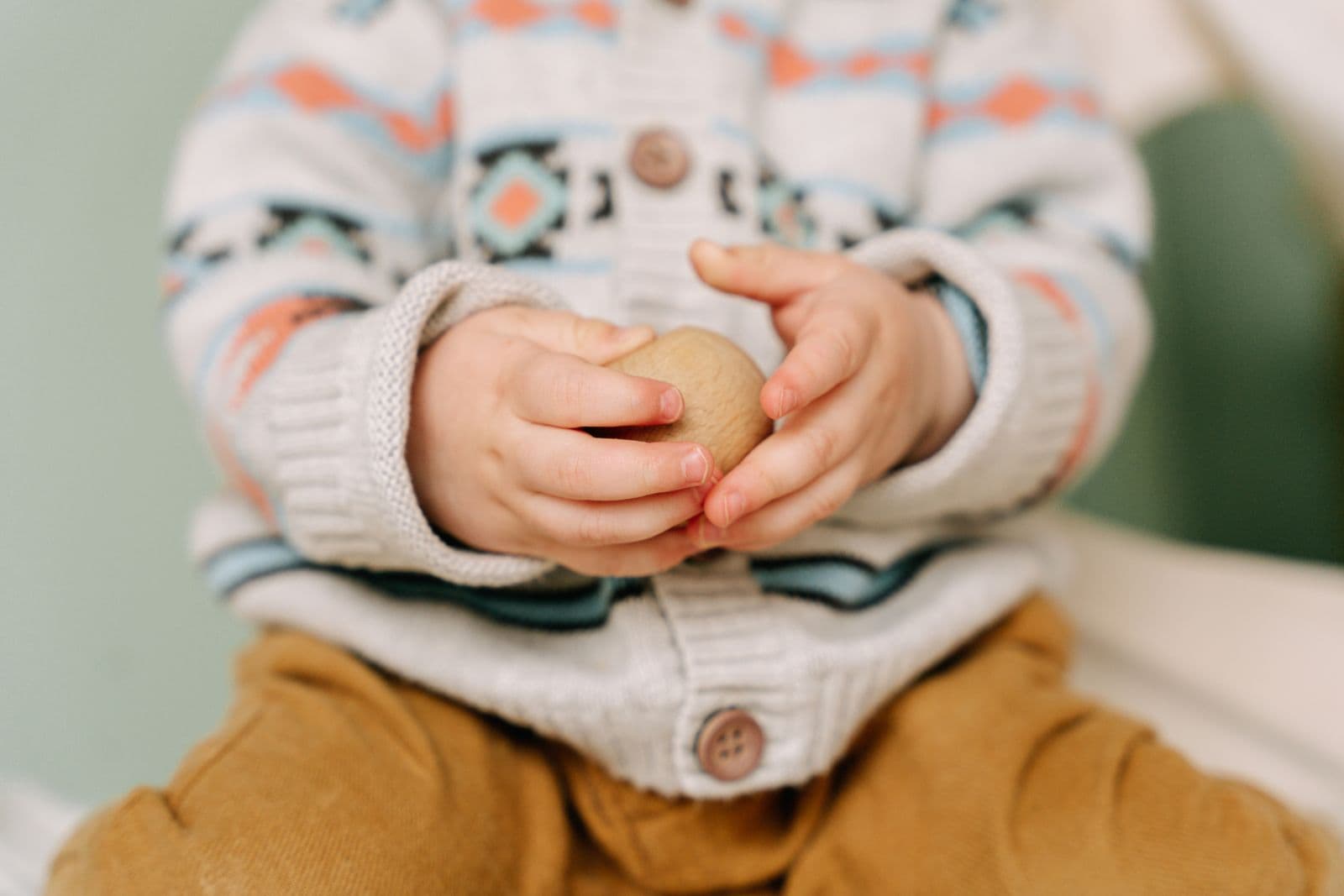
Voluntary reach arrives, then a whole-hand palmar grasp. Everything obtained goes into the mouth, which is not a phase to discourage since it is how a baby gathers information about objects.
What works. Lightweight rattles a small hand can hold, ideally with a narrow section to grip. Teethers of varied texture. Crinkly cloth books. Detachable play gym toys, now used off the arch. Anything safe to mouth, which at this stage is the only mode of investigation there is.
The specification that matters. Weight and grip diameter. A rattle too heavy or too fat to hold is a rattle a baby drops, and it will read as disinterest rather than as a fit problem.
About 6 to 9 months: sitting, transferring, banging
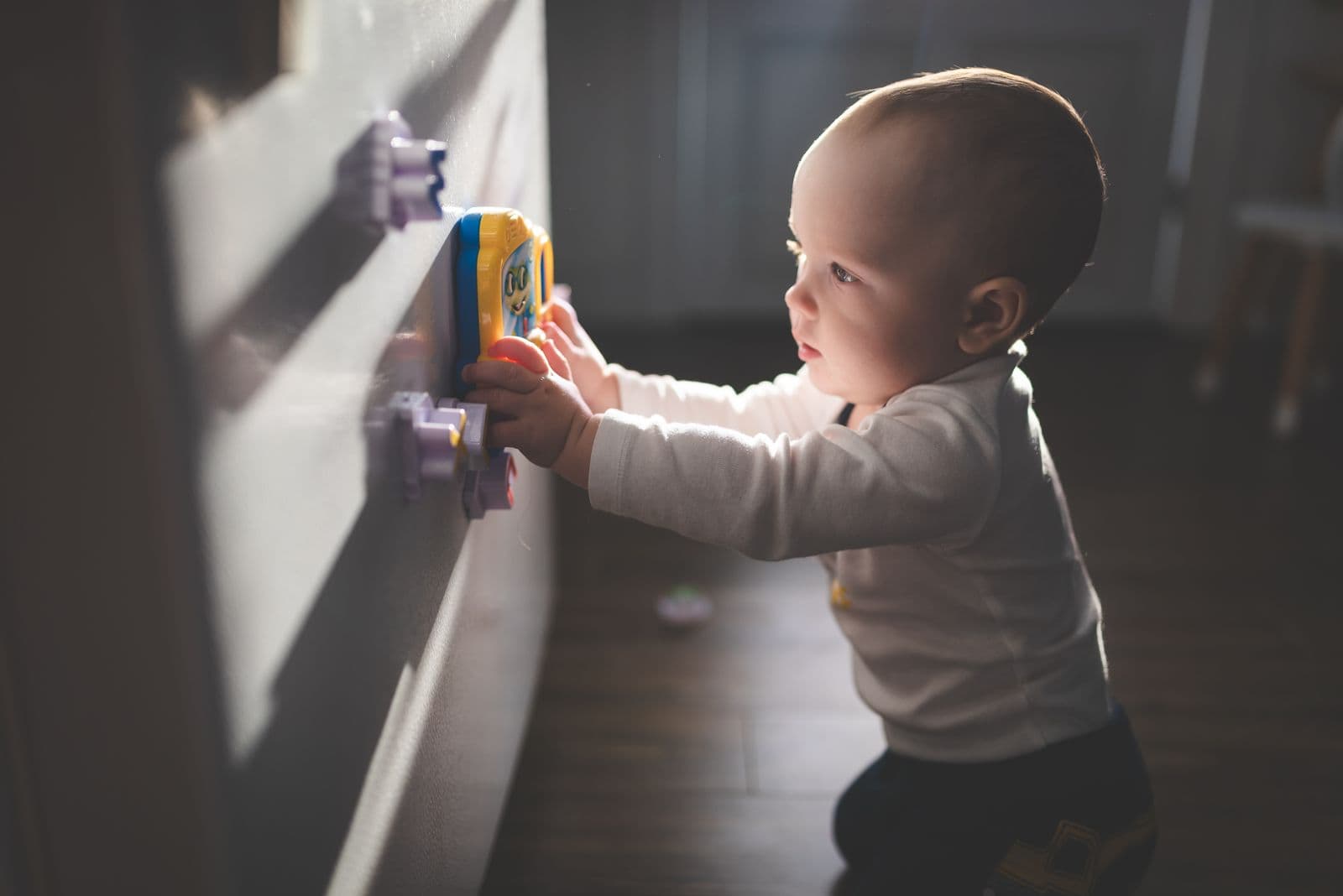
Sitting frees both hands. Objects get passed hand to hand, banged together, and dropped repeatedly to see what happens, which is early cause-and-effect rather than mischief.
What works. Stacking cups, which have more uses than any other object at this price. Soft blocks. Balls. Simple cause-and-effect toys where the child's own action does something, such as a pop-up or a rolling toy. Board books, handled as much as read.
Not yet. Stacking rings in order, shape sorters, and anything needing a pincer grip. They can be held and mouthed, and the intended use is a few months off.
About 9 to 12 months: pincer grip and containers
Thumb and forefinger arrive, which changes everything. Small objects can be picked up deliberately, which is also when the choking-hazard question becomes live in a new way. The dominant interest becomes putting things into and taking them out of other things.
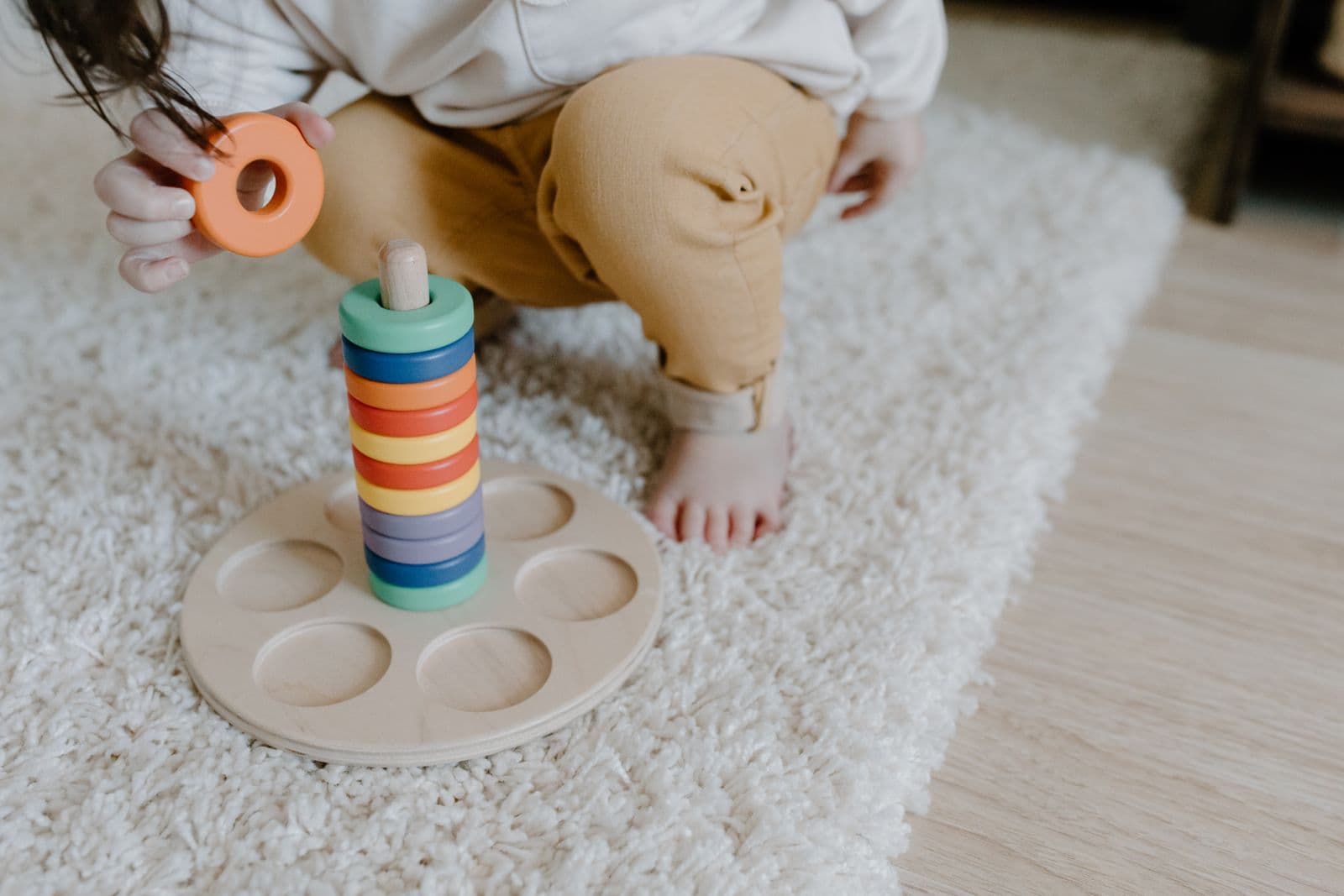
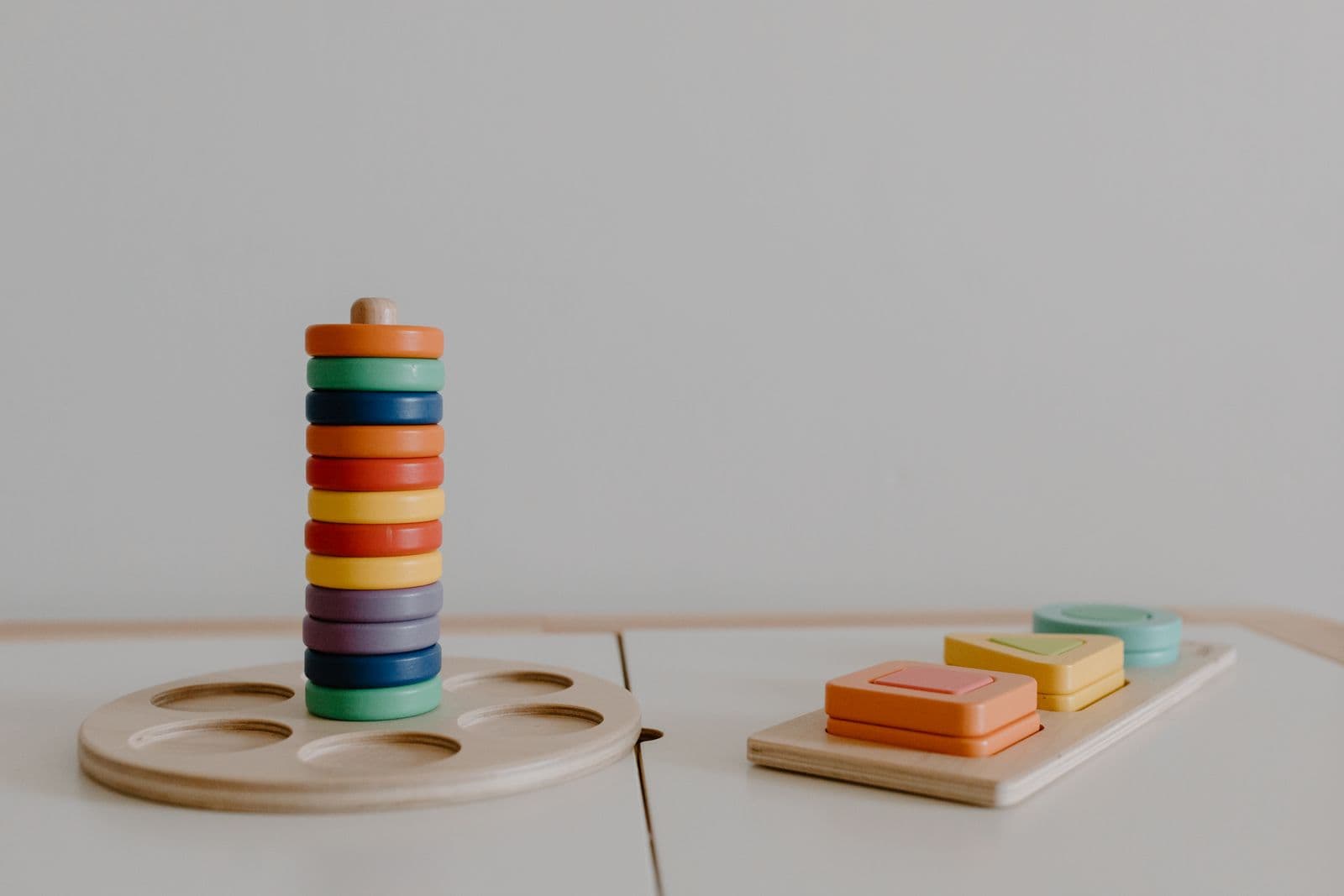
What works. Containers and objects that fit in them, which is where stacking cups earn their place a second time. Simple shape sorters, usually starting with one hole. Stacking rings, first as objects to remove from the post and later to replace. Push and pull toys once the child is pulling to stand.
The rule that starts mattering now. Anything that fits through a toilet-roll tube is a choking hazard for a child under three. That tube is a reasonable stand-in for the small-parts cylinder used in toy testing, and it is worth keeping one in a drawer. What that federal test actually checks, and where a 2017 review found it fell short, is covered in choking hazards in toys.
12 to 24 months: doing what the object is for
Real manipulation, early pretend play, and a strong interest in doing what adults do.
What works. Blocks, which are now built with rather than knocked over. Simple puzzles with knobs. Toy versions of household objects, meaning a phone, a broom, a set of pans. Crayons. Anything that can be filled, emptied, carried and posted.
The buying strategy that follows
Buy at the stage, not ahead of it. The exception is anything given as a gift, which arrives whenever it arrives.
Rotate rather than accumulate. A small selection out at a time, swapped every couple of weeks, produces longer and deeper play than a full toy box. A child facing thirty options samples thirty options.
Prefer things that survive re-use at multiple stages. Stacking cups are the outstanding example, usable from six months to three years in completely different ways. Blocks are the other.
Skip the newborn aisle almost entirely. A play gym, a mirror and high-contrast cards is the whole list, and the rest can wait until there is a hand that can hold it.
Household objects count. Measuring cups, a wooden spoon, a muffin tin and a cardboard box cover a remarkable proportion of the first eighteen months, and they are already in the kitchen.
Reading the age label
The age grading on a toy is a safety classification rather than a difficulty rating. "3+" on a simple-looking toy almost always means small parts, not that the toy is too hard. It comes from ASTM F963, the toy safety standard that 16 CFR Part 1250 makes mandatory, and the small-parts test behind it is a real, physical one.
So the grading is worth following exactly, and it is not a guide to what your baby is ready for. The stages above are the guide to that, and the two answer different questions.
Where this sits
Whether any of these toys is meaningfully "developmental" is the subject of do developmental toys do anything, and the answer involves a study in which the toys that talk came last. The largest floor purchases, including the one the AAP has asked to have banned, are compared in play gyms and activity centers, and the specific picks that stay useful longest are in the best first toys.
None of this belongs in a crib at any stage, which is covered in the cribs and bassinets guide, and the rest of the room the floor time happens in is under Nursery Essentials.
Questions people actually ask
When can a baby use a shape sorter?
Meaningfully, somewhere around nine to twelve months, and even then usually starting with a single hole. Earlier than that it is an object to hold and mouth, which is fine and is not what it was bought for. Stacking cups do the same job earlier and for longer.
Why does a simple toy say 3+?
Because of small parts, almost always. The age grading is a safety classification derived from ASTM F963 and a physical small-parts test, not a judgement about difficulty. Follow it exactly, and do not read it as a comment on your child's ability.
How many toys does a baby actually need?
Fewer available at once than most homes have. Rotating a small selection every couple of weeks produces longer and more sustained play than leaving everything out, because a child facing thirty options tends to sample all thirty rather than settle into any.
Are wooden toys better than plastic?
Not for development. Both meet the same safety standard, and the properties that matter are whether the toy is open-ended and whether it is quiet. Wooden toys are more often both, which is why they show up in this kind of guide, and that is a correlation rather than a property of the material.
What is the single best-value toy of the first year?
Stacking cups, by a wide margin. They are containers at six months, nesting objects at nine, stacking objects at twelve, bath toys throughout and sand toys later, and they cost less than almost anything else on the shelf.
Sources
As an Amazon Associate we earn from qualifying purchases. We earn a commission on some links, at no extra cost to you. It never changes which products we recommend or the order they appear in. Full disclosure

Who wrote this
Writer, standards and the recall record
Dan Whitfield writes the standards side of BabyGearSearch: what a certification actually covers, what the CPSC recall database says about a brand, and what the one-star reviews agree on six months in. He is not a clinician and does not write as one. His job is to read the standard rather than the marketing page, quote the real number, and name the limit the packaging skipped.
More from DanThe standard
How this guide was built
- Manufacturer specification sheets and warranty terms, read in full rather than summarised from a listing.
- The federal safety standard the product is certified to, plus anything NHTSA, the AAP or the CPSC has published on it.
- Owner reports at volume, including the one-star reviews, which is where failure modes live.
- Every price checked against the live listing on the date printed beside it.