When to Take Down a Crib Mobile, and Why a Crib Gym Is a Different Rule
The hands-and-knees rule, where it came from in CPSC's crib toy files, and the four ways a crib mobile has been recalled since.
- Writer, standards and the recall record
- Oct 4, 2026
- 14 min read
In this guide
- The rule, word for word
- Three kinds of crib toy, as CPSC defines them
- Where the 5-month number comes from
- Why "hands and knees" and not an age alone
- Bare is best, and a mobile is not in the crib
- Four ways crib mobiles have been recalled
- The standard behind a new mobile
- A five-point check, while the mobile is up
- After it comes down
- Sources
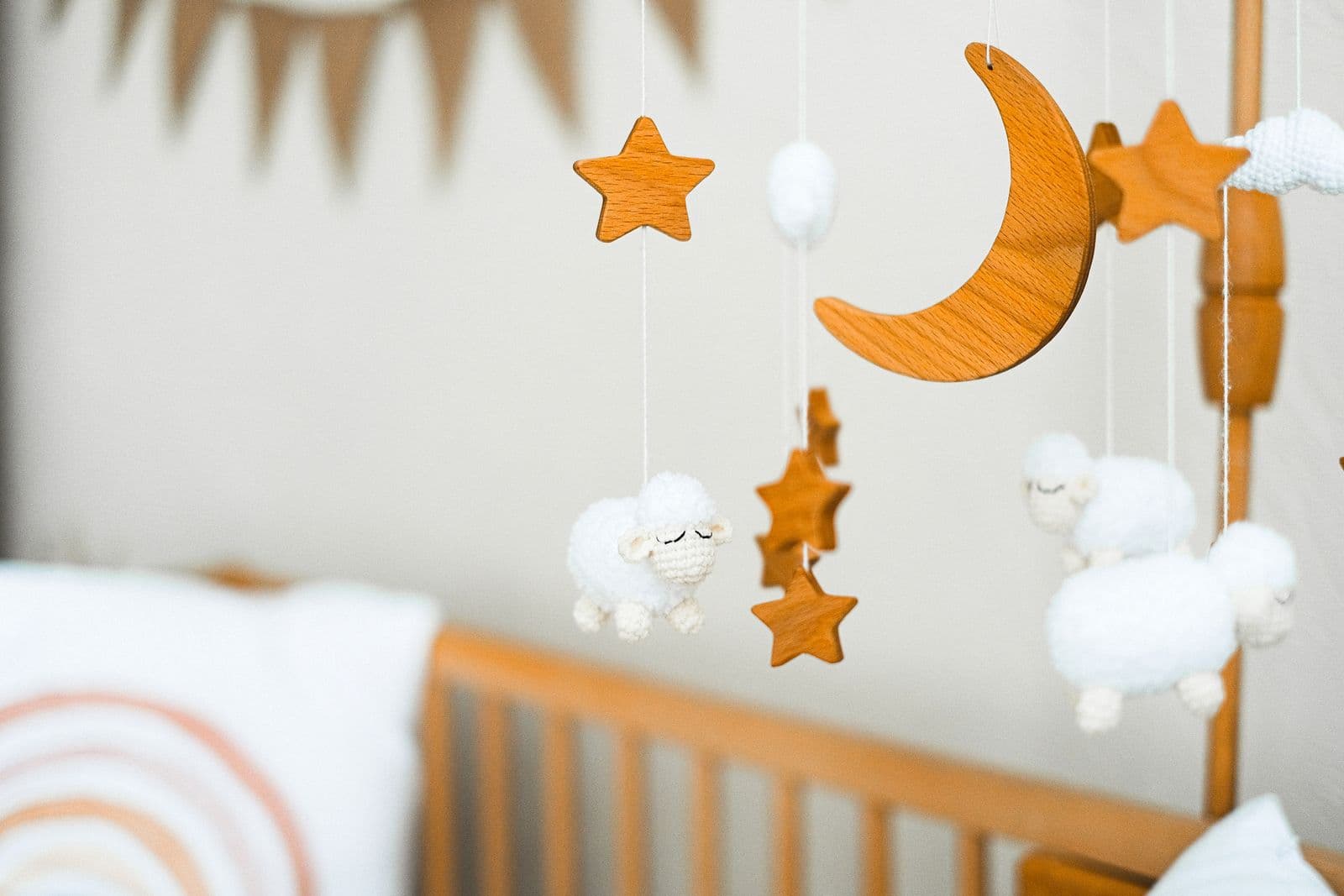
A crib mobile has the shortest working life of anything in a nursery. The American Academy of Pediatrics, through its parent site HealthyChildren.org, says to take it down when the baby can get up on hands and knees, or at 5 months old, whichever comes first. For many babies that is a few months of use, and the mobile was often bought before the birth.
The rule is older than most parents assume, and it is more specific than "when the baby can reach it." It was written into Consumer Product Safety Commission files in the 1980s, after deaths involving toys strung across cribs, and it has stayed the same number ever since. This guide reads those files, sets out what the current guidance actually says, and covers the four ways crib mobiles have been recalled in the decades since. Nothing here ranks a mobile, and nothing here claims a mobile does anything for a baby's development.
The rule, word for word
HealthyChildren.org's nursery checklist gives three instructions for a mobile, in this order:
- Attach it securely to the side rails, the wall or the ceiling.
- Hang it high enough that the baby cannot reach it to pull it down.
- Remove it when the baby is able to get up on hands and knees, or is 5 months old, whichever comes first.
The same checklist then says something about a different product that is easy to miss: crib gyms are not recommended. The reason given is that infants and toddlers may injure themselves falling forward onto the gym, or by pulling the gym down on top of their body.
That distinction matters, because the two products look similar on a shop shelf and are not the same thing. A mobile hangs above the crib, out of reach. A crib gym is strung across the crib, within reach, by design. The AAP gives the first a deadline and does not recommend the second at all.
Three kinds of crib toy, as CPSC defines them
In 1993 the Commission described crib toys as three groups:
- Toys strung across a crib or playpen, which it named as crib gyms, exercisers and kickers.
- Toys attached to a corner post or side rail, the activity or busy boxes.
- Toys hung above the crib or playpen, out of the child's reach, which are crib mobiles.
The first group is where the deaths were. The third group, the mobile, is the one parents still buy in volume. The 5-month rule covers both, because a mobile that is out of reach at 3 months is not necessarily out of reach at 6, and a mobile that has been pulled down is a crib toy lying in the crib.
Where the 5-month number comes from
The number traces through three CPSC releases, read in date order.
1984: the Fisher-Price #155 Play Gym. In October 1984 CPSC and Fisher-Price issued a safety alert on an activity bar that attached across a crib. The company had received a report that a one-year-old died when a hooded sweater became entangled on the gym, and a previous death had been reported in May 1980 after a child's clothing caught on one. The alert records that Fisher-Price had voluntarily begun labeling the toy in 1981, telling parents to remove it when the child could push up on hands and knees or reached 5 months of age. The problem the alert addressed was the unlabeled gyms still in use from before that change. The Commission and the company also advised against putting a baby in a crib in hooded clothing or any loose-fitting garment that could tangle around the neck.
1989: crib kickers. In June 1989 CPSC and Red Calliope of Los Angeles warned about an estimated 20,000 crib kickers sold between 1980 and 1985. These were rows of polyester-filled figures with two long ribbons at each end, for tying across a crib or playpen. CPSC's description of the hazard is exact: a child who can push up on hands and knees may become entangled in the loops the ribbons form, or may fall across the toy and be asphyxiated. The toy itself carried no warning. A note to parents had been in the retail package, and the release points out that once the package was thrown away, the information went with it. CPSC's instruction was to remove crib toys hung across a crib or playpen when the baby reaches five months, and to discard any unlabeled crib kicker, including one stored away for a later baby.
1993: the rule that was not written. In 1990 CPSC granted a petition from the Consumer Federation of America and the Attorney General of New York to consider a mandatory rule for crib toy strangulation hazards. In October 1993 the Commission voted unanimously to end that rulemaking. Its stated reasons were fewer than two crib toy related deaths a year over 20 years, against estimated annual sales of 10 to 25 million units, no information showing a mandatory standard would reduce deaths further, and a staff judgment that proposed changes to the voluntary standard would address most of the petitioners' concerns.
Read together, the three releases explain the shape of the rule today. The hazard was real but rare, the fix was a warning on the toy rather than on the box, and the trigger was a developmental milestone with an age attached as a backstop.
Why "hands and knees" and not an age alone
A baby lying on their back under a mobile is in the position the product was designed for. A baby who can push up onto hands and knees changes the geometry in two ways at once. They can now reach higher than they could lying flat, and they can fall forward, onto whatever is strung across the crib or onto whatever they have pulled down.
That is why the guidance names the milestone first and the age second. Babies reach the milestone at different times, and the "whichever comes first" wording means a baby who gets onto hands and knees at 4 months has already passed the deadline, while a baby who has not by 5 months has passed it anyway. A date on the calendar is easier to remember than a milestone, so set the 5-month date when the mobile goes up, and treat the first push-up onto hands and knees as an earlier alarm. For what a baby can typically do month by month, toys by development stage sets out the sequence.
Bare is best, and a mobile is not in the crib
CPSC's safe sleep guidance is short. "Bare is Best" means nothing but a fitted sheet in a crib, bassinet or play yard. HealthyChildren's checklist adds that pillows, quilts, comforters, sheepskins, stuffed animals and other soft products should not go in a crib, and that strings and cords should not dangle in or near it.
A properly hung mobile does not break that rule, because it is above the crib rather than in it. Three situations put it back inside the rule:
- A mobile within reach. Anything a baby can grab can be pulled into the sleep space, which is exactly what the AAP's "high enough" instruction is there to prevent.
- A mobile that falls. A clamp, strap or arm that fails puts the whole assembly in the crib. One of the recalls below is exactly that.
- A mobile with soft figures. Crocheted animals and felt shapes are the soft products the crib itself must not contain, so a figure that detaches lands where the rules say it never should be.
Four ways crib mobiles have been recalled
CPSC's recall archive holds crib mobile recalls across four decades, and each one describes a different failure. Reading them is a useful checklist for any mobile, new or handed down.
The mount failed: Skip Hop, December 2015. Skip Hop recalled about 3,500 Moonlight & Melodies projection crib mobiles, model 185509, because the strap attaching the mobile to the crib rail could break and the mobile could fall on an infant in the crib. The company had 8 reports of the strap breaking and no injuries. They were sold from July to November 2015 for about $65, at Babies R Us, Buy Buy Baby, specialty stores, Amazon and skiphop.com.
The battery door was too easy: Youbeien, September 2025. About 3,000 Youbeien crib mobiles, model RT668-17, sold on Amazon from May 2024 through April 2025 for about $20, were recalled because the button battery compartment in the remote control could be opened without a common household tool. That violates the mandatory standard for toys containing button batteries. The recall notice allows owners to throw away only the remote for a partial refund, since the mobile runs from buttons on the unit. The rule behind this recall is covered in full in button batteries and magnets in toys.
The batteries leaked: Fisher-Price, June 2003. Fisher-Price recalled 233,000 Sparkling Symphony Mobile crib toys, model 71985, made from October 1999 through November 2000, because batteries could leak caustic liquid out of the compartment. The company had 30 reports of leaking batteries, including six reports of minor burns to babies. The remedy was a free repair kit with a seal for the battery compartment.
The paint had lead in it: Woodcrafter Kits, June 1987. A small run of 364 LP-205 Musical Mobile toys was recalled because the red paint on the clear plastic rings contained about 8 percent lead and flaked off easily. The regulation in force at the time allowed no more than 0.06 percent lead in paint. No poisoning incidents were known.
Every one of these failures shares a feature. None of them is visible on the day the mobile goes up. A strap that breaks, a battery door a toddler can open, a seal that fails and paint that flakes all show up with time, which is the strongest argument for checking the mobile weekly while it is in use.
The standard behind a new mobile
A crib mobile sold in the United States is a toy, and every toy must comply with ASTM F963, the consumer safety specification for toys. Federal law makes that standard mandatory through 16 CFR Part 1250, and the current eCFR text incorporates the 2023 edition, F963-23. The 1993 decision above deliberately left crib toys to the voluntary standard, and 16 CFR Part 1250 has since made that standard mandatory.
Two practical points follow. First, the standard tests the product as sold, so a mobile that has been dropped, re-strung or clamped to a rail it was not made for is outside what any test promised. Second, a handed-down mobile may predate the current edition entirely, and the 1984 and 1989 releases both exist because older toys without labels stayed in use for years. For the separate small-parts test, which is relevant to any mobile with detachable figures, see what the small parts test actually checks.
A five-point check, while the mobile is up
- Mount. Clamp or strap tight to a rail it fits, or fixed to the wall or ceiling per the instructions. Pull on it. It should not shift.
- Reach. Lowest figure out of the baby's reach, with the baby on their back and arms fully up. Re-check every few weeks, because reach grows fast.
- Figures. Pull gently on every hanging figure and every eye, bead or button sewn to one. Anything that loosens comes off the mobile for good.
- Batteries. Compartment screwed shut, screw present, no white crust at the terminals. Check the remote too, since the Youbeien recall was in the remote, not the mobile.
- Recalls. Search the CPSC recall database by brand and model number, which is printed on the base or arm on most mobiles. That matters most for a secondhand mobile.
After it comes down
Taking the mobile down does not end the reason it was bought. A baby who has reached the hands-and-knees stage is on the move, and that play belongs on the floor, awake and supervised. Play gyms and activity centers covers the floor-level frame that does the mobile's job in the daytime, without being strung across a sleep space. For what to put in a baby's hands at the same age, the best first toys ranks five on working life.
Do not move the mobile into a play yard or a travel crib once it leaves the main crib. CPSC's 1984 and 1989 releases name cribs and playpens together, and the hands-and-knees limit applies to both.
Questions people actually ask
At what age should a crib mobile come down?
The AAP's HealthyChildren.org says to remove a mobile when the baby can get up on hands and knees, or at 5 months old, whichever comes first. A baby who pushes up early has passed the deadline early, and a baby who has not pushed up by 5 months has passed it anyway.
Is a crib gym the same thing as a mobile?
No. A mobile hangs above the crib out of reach, while a crib gym is strung across the crib within reach. HealthyChildren.org says crib gyms are not recommended, because a baby can fall forward onto the gym or pull it down onto themselves. CPSC's 1984 and 1989 releases about deaths and hazards involved toys strung across cribs, not mobiles hung above them.
Can a crib mobile stay up if it is high enough that the baby cannot reach it?
The guidance does not make that exception. The 5-month or hands-and-knees limit applies on top of the instruction to hang the mobile out of reach, partly because reach grows quickly and partly because a mount that fails drops the whole mobile into the crib, which is the hazard in Skip Hop's 2015 recall.
Is a secondhand crib mobile safe to use?
Check it against the CPSC recall database by brand and model number before it goes up. CPSC's crib toy releases from 1984 and 1989 both dealt with older toys that lacked the warning label newer ones carried, and recalls since then have covered broken mounts, accessible button battery compartments, leaking batteries and lead paint.
Does a crib mobile help a baby's development?
Nothing in the CPSC or AAP guidance cited here makes a developmental claim for a mobile, and neither does this guide. A mobile is something for a young baby to look at, and the floor-level play that follows it is covered in the guide to play gyms and activity centers.
Sources
- HealthyChildren.org (American Academy of Pediatrics), Make Baby's Room Safe: Parent Checklist
- CPSC, Remember CPSC's "dos and don'ts" for baby sleep spaces
- CPSC, CPSC and Fisher-Price Issue Crib Toy Safety Alert, recall 84-058, October 10, 1984
- CPSC, Strangulation Risk Prompts Warning About Crib Kickers, release 89-050, June 6, 1989
- CPSC, CPSC Decision: Mandatory Rulemaking for Crib Toys Withdrawn, release 94-005, October 26, 1993
- CPSC, Skip Hop Recalls Crib Mobiles, recall 16-059, December 16, 2015
- CPSC, Youbeien Crib Mobiles Recalled Due to Risk of Serious Injury or Death from Battery Ingestion, recall 25-471, September 18, 2025
- CPSC, CPSC, Fisher-Price Announce Recall of Crib Mobile Toys, recall 03-146, June 20, 2003
- CPSC, Musical Crib Mobile Recalled, recall 87-033, June 4, 1987
- eCFR, 16 CFR Part 1250, Safety Standard for Toys
As an Amazon Associate we earn from qualifying purchases. We earn a commission on some links, at no extra cost to you. It never changes which products we recommend or the order they appear in. Full disclosure

Who wrote this
Writer, standards and the recall record
Dan Whitfield writes the standards side of BabyGearSearch: what a certification actually covers, what the CPSC recall database says about a brand, and what the one-star reviews agree on six months in. He is not a clinician and does not write as one. His job is to read the standard rather than the marketing page, quote the real number, and name the limit the packaging skipped.
More from DanThe standard
How this guide was built
- Manufacturer specification sheets and warranty terms, read in full rather than summarised from a listing.
- The federal safety standard the product is certified to, plus anything NHTSA, the AAP or the CPSC has published on it.
- Owner reports at volume, including the one-star reviews, which is where failure modes live.
- Every price checked against the live listing on the date printed beside it.