The Best Ride-On Toys for Toddlers, Matched to Who Does the Pushing
Three ride-on toys from $44.99 to $89.99, sorted by whether the toddler's feet or a parent's hands move them, with the tipping and recall record behind each.
- Writer, standards and the recall record
- Oct 20, 2026
- 13 min read
3 products compared

In this guide
A ride-on toy is the first thing a toddler owns that moves under their own power, and that is the whole case for one. Long before pedals make sense, a child who can sit and walk can push a low seat along with both feet, steer it into a wall, back it out and try again.
That last part matters more than any feature on the box. Ride-ons come in two quite different kinds, and buying the wrong kind is the usual mistake in this aisle. A foot-to-floor ride-on is moved by the child's own legs. A push car has a tall handle at the back and is moved by an adult, with the child as passenger. Some toys try to be both. The three picks below are sorted on that one question, who supplies the push, because it decides how old the child should be, how much room the toy needs and how long it stays in use.
What separates one ride-on from another
Who moves it. A foot-to-floor toy asks the child to sit low, reach the ground flat-footed and shove. Toddlers who are walking steadily take to it quickly. A push car asks nothing of the child except to sit still, which is why it can start earlier and why it competes with a stroller rather than with other toys.
How low it sits, and how wide. A low seat over a wide wheelbase is harder to roll sideways. That principle is the reason the American Academy of Pediatrics tells parents to look for a tricycle that is built low with big wheels, since that design is less likely to tip. The same reasoning applies one stage earlier to a ride-on.
What stops the forward fall. A recurring failure in the CPSC recall record for this category is not a toy breaking. It is a child leaning forward and going over the front. Little Tikes recalled about 21,400 Pop 'n Scoot ride-ons in 2002 after 10 reports of children falling forward over the handlebars, with injuries that included damaged teeth and stitches to the chin. Step2 recalled about 15,500 X-Rider cars in 2012 for the same pattern, a child leaning too far forward on the seat and going over the handlebar. A design with a wide front stance, a bumper out front or an enclosed body is answering that problem directly.
What the federal standard covers. Toys sold in the US must meet the applicable provisions of ASTM F963-23, which 16 CFR Part 1250 makes mandatory. That standard has a section on stability and over-load requirements, with separate test methods for the stability of ride-on toys and toy seats, for overload of ride-on toys and toy seats, and a dynamic strength test for wheeled ride-on toys. Passing it means the toy resisted tipping and breaking under a defined laboratory load. A toddler steering into a curb or down a step is outside anything a bench test can promise.
The picks
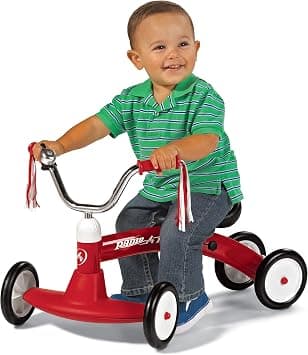
$44.99
Price checked Oct 20, 2026
Radio Flyer Scoot About
This is the plain foot-to-floor ride-on done carefully. Radio Flyer sets the front wheels wide apart for side-to-side balance and the rear wheels narrow, which leaves a clear path for the child's feet to kick without clipping a wheel. The seat height adjusts as the child grows, a bumper across the front protects furniture, and the frame is steel under a chrome-finished handlebar. Radio Flyer rates it for ages one to three and up to 42 pounds. It is wrong for a baby who is not yet walking confidently, because every inch of progress comes from the child's own legs and there is no handle for an adult to help.
We may earn a commission on this link. It never changes the ranking.
- Ages
- 1 to 3 years
- Who pushes
- The child, feet on the floor
- Weight limit
- 42 lb
- Size
- 23.54 x 18.98 x 17.64 in, 17.2 lb
What works
- The only pick here that the child powers entirely, which is the point of a first ride-on
- Wide front wheels and a narrow rear track keep the kick path clear
- Adjustable seat height stretches it across the one-to-three range
- Front bumper for indoor use around furniture
What to know
- No push handle, so it does nothing for a child who cannot yet propel it
- 42-pound limit, the lowest of the three
- A bell and streamers are the only extras, which is a feature to some parents and a gap to others
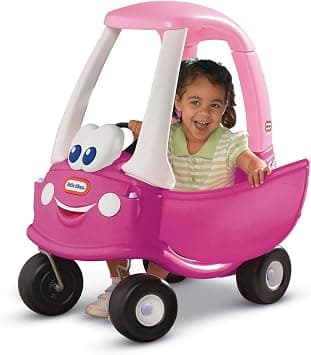
$66.99
Price checked Oct 20, 2026
Little Tikes Princess Cozy Coupe (Magenta)
The Cozy Coupe works both ways. With the floorboard in, a toddler's feet rest inside the car and an adult pushes from a handle on the back. Take the floorboard out and the same child drives it with their feet. Little Tikes rates it from 18 months to 5 years and up to 50 pounds, the widest age window of the three. The enclosed body puts sides and a roof around the child, so there are no handlebars to go over. It is wrong for a small apartment, at 29.5 inches long and 33.5 inches tall, and for a household that wants a toy to fold away, because it does not.
We may earn a commission on this link. It never changes the ranking.
- Ages
- 18 months to 5 years
- Who pushes
- Adult with floorboard in, child with it out
- Weight limit
- 50 lb
- Size
- 29.5 x 16.5 x 33.5 in, 17.25 lb
What works
- Two modes, parent-pushed with the floorboard in and foot-powered with it out
- Widest age range here, 18 months to 5 years
- Enclosed body with no handlebar to tip over
- Little Tikes lists the Princess Magenta at $64.99 on its own store, in line with this price
What to know
- Bulky and does not fold, at 29.5 x 16.5 x 33.5 inches
- Adult assembly required
- Its size works against it indoors, so most of its life is spent outside
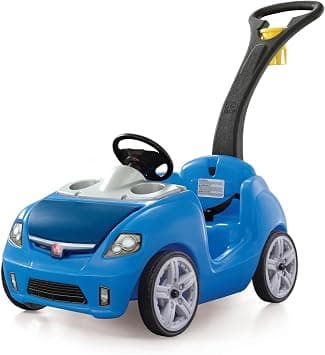
$89.99
Price checked Oct 20, 2026
Step2 Whisper Ride II Push Car (Blue)
The Whisper Ride II is a push car first and a toy second. An adult steers and pushes from a wide-grip handle that folds down for storage, and the child rides buckled in with the included seat belt, holding a pretend steering wheel with a working horn. Cup holders and an under-hood compartment take a drink and a snack. Step2 rates it from 18 months and up to 50 pounds. It is wrong as a toy for building leg strength or independence, because the child supplies none of the movement, and it is the largest pick here at 45.5 inches long and 34 inches high.
We may earn a commission on this link. It never changes the ranking.
- Ages
- 18 months and up
- Who pushes
- Adult, from the rear handle
- Weight limit
- 50 lb
- Size
- 45.5 x 19 x 34 in
What works
- Seat belt keeps a younger toddler in place during a walk
- Fold-down push handle for the car trunk or a closet
- Under-hood storage and cup holders, the most carrying space of the three
- Same 50-pound limit as the Cozy Coupe
What to know
- The child does nothing to move it, so it does not teach riding
- Largest footprint here, 45.5 x 19 x 34 inches
- Highest price of the three
The comparison, in one table
| Ride-on | Price | Who pushes | Ages | Weight limit |
|---|---|---|---|---|
| Radio Flyer Scoot About | $44.99 | Child | 1 to 3 years | 42 lb |
| Little Tikes Princess Cozy Coupe | $66.99 | Adult or child | 18 months to 5 years | 50 lb |
| Step2 Whisper Ride II | $89.99 | Adult | 18 months and up | 50 lb |
Who each one is wrong for
Skip the Scoot About for a child who is still cruising along furniture. A foot-to-floor toy needs a toddler who can stand up, step over it and sit down without help, and a child who is still pulling to stand is better served by something to push from behind. That stage has its own roundup in push walkers for learning to walk.
Families in a one-bedroom apartment should think hard before buying the Cozy Coupe. It is a piece of furniture-sized plastic that does not fold, and its best years are spent outdoors. With a garden or a garage it is the obvious pick. Without one it may spend months parked in a hallway.
The Whisper Ride II is a poor choice for a parent who already owns a good stroller. It overlaps that job almost completely, with a seat belt and a handle, and adds a steering wheel and a horn. Its real use is the short walk where a toddler refuses the stroller but cannot yet keep up on foot.
Which one to buy
For a child between roughly 18 months and three who is walking well, the Scoot About is the default. It is the cheapest of the three, the smallest to store, and the only one that asks the child to do the work, which is most of what a ride-on is for.
If the toy has to cover a long span, starting before a child can propel anything and lasting into the preschool years, the Cozy Coupe is the one pick with two working modes.
If what the household actually wants is a buckled seat on wheels for walks, the Whisper Ride II does that job with a handle at adult height and storage for the trip.
For the wider picture of what a toddler can physically manage at each age, and which toys line up with it, see toys by development stage. Whatever ride-on is chosen, it builds the skill a child practices on it and nothing more, a point made at length in do developmental toys do anything.
Where a ride-on is safe to ride
The hazard with a ride-on is rarely the toy. It is where the toy goes. A toddler on a foot-powered car can cover a room in seconds and has no brakes beyond their own feet, which makes the top of a staircase the most dangerous place in the house. Keep a gate closed across every stair while a ride-on is in use, and keep porches, decks and steps out of the riding area.
Outdoors, the AAP's tricycle guidance is the best fit for the next size up and applies just as well here. A child low to the ground cannot be seen by a driver who is backing up, so driveways and anywhere near parked or moving cars are off limits. The same guidance keeps riding away from swimming pools and limits it to protected places. The Consumer Product Safety Commission's most recent toy injury report counted an estimated 83,800 emergency department visits in 2023 for toy-related injuries among children four and under, and noted that a motor vehicle collision with an unpowered scooter was among the year's toy-related deaths.
Older ride-ons deserve one more check. Step2 recalled about 2.5 million Push Around and Whisper Ride Buggies in 2010 because a pin at the yellow knob on the handle could loosen and let the handle detach from the buggy. The recall covered buggies sold from August 1999 through March 2010, and it is the reason a secondhand Step2 buggy from that era should be checked before anyone rides in it. Small parts are the other inherited risk. Accessories, bells and stickers on a hand-me-down ride-on are worth checking against the small-parts test when a younger sibling is around.
Questions people actually ask
What age can a toddler start on a ride-on toy?
It depends on the kind. A foot-to-floor toy like the Scoot About suits a child who is walking steadily, and Radio Flyer rates it from age one. A push car or a Cozy Coupe with its floorboard in can start a little earlier because an adult does the pushing, and both makers here rate theirs from 18 months.
Is a ride-on toy better than a push walker?
They do different jobs at different stages. A push walker is for a baby who is pulling to stand and needs something to walk behind. A ride-on is for a child who already walks and can sit, push off and steer. Many children use a push walker first and move to a ride-on months later.
When should a child move from a ride-on to a tricycle?
The American Academy of Pediatrics says most children are ready for a tricycle around age three, and recommends a low model with big wheels plus a properly fitted bicycle helmet for every ride. A ride-on covers the gap before that.
Are ride-on toys fine indoors?
Foot-to-floor toys are made for it, and the Scoot About has a front bumper for exactly that reason. Larger push cars are built mostly for walks outside. Indoors or out, the stairs are the main danger, so keep a gate closed across them.
Do ride-on toys help a child walk sooner?
No ride-on is shown to speed up walking. A foot-powered toy gives a child who already walks a way to practice pushing, balance and steering, and that is the honest claim. A question about when a child should be walking belongs with a pediatrician.
Sources
- CPSC: Step2 recalls to repair riding toys due to risk of injury (2010)
- CPSC: Children's riding toy recalled by Step2 due to fall hazard (2012)
- CPSC: Little Tikes Pop 'n Scoot ride-on toy recall (2002)
- CPSC: Toy-Related Deaths and Injuries, Calendar Year 2023
- eCFR: 16 CFR Part 1250, Safety Standard for Toys
- ASTM F963-23, Standard Consumer Safety Specification for Toy Safety
- American Academy of Pediatrics, HealthyChildren.org: Ready for a tricycle?
- Radio Flyer: Scoot About specifications
- Little Tikes: Princess Cozy Coupe, Magenta
- Step2: Whisper Ride II
As an Amazon Associate we earn from qualifying purchases. We earn a commission on some links, at no extra cost to you. It never changes which products we recommend or the order they appear in. Full disclosure

Who wrote this
Writer, standards and the recall record
Dan Whitfield writes the standards side of BabyGearSearch: what a certification actually covers, what the CPSC recall database says about a brand, and what the one-star reviews agree on six months in. He is not a clinician and does not write as one. His job is to read the standard rather than the marketing page, quote the real number, and name the limit the packaging skipped.
More from DanThe standard
How this guide was built
- Manufacturer specification sheets and warranty terms, read in full rather than summarised from a listing.
- The federal safety standard the product is certified to, plus anything NHTSA, the AAP or the CPSC has published on it.
- Owner reports at volume, including the one-star reviews, which is where failure modes live.
- Every price checked against the live listing on the date printed beside it.