When to Stop Using a Baby Monitor: The Signals That Beat a Birthday
No agency prints a stop date on a baby monitor. What decides it is the cord, the sock's size range and the move to a bed, and the order matters.
- Writer, standards and the recall record
- Oct 3, 2026
- 15 min read

In this guide
- There is no official stop date, and that is deliberate
- The months when stopping feels right are the riskiest for a cord
- Wearables age out on a printed range
- Moving to a bed is a reason to keep a camera, not drop it
- The softer signals that a monitor has done its job
- A step down before the full stop
- Retiring a monitor properly
- Sources
A baby monitor box tells you the camera's resolution, the range of the parent unit and the length of the power cord. It does not tell you when to put the thing away, and neither does any federal agency. The American Academy of Pediatrics publishes detailed sleep guidance for the first year, the Consumer Product Safety Commission publishes rules about where a monitor's cord may sit, and a wearable sock prints an age and weight range on its own product page. None of them says "stop at two."
That gap is why the question gets answered by feel, usually around the first birthday, when nights get calmer and the app notifications start to look like noise. The problem with deciding by feel is that the months when a monitor seems least necessary overlap almost exactly with the months when a corded camera is most dangerous. So this guide works through the decision in the order the evidence suggests: the cord first, the wearable second, the move to a bed third, and only then the softer signals that the monitor has done its job.
There is no official stop date, and that is deliberate
The AAP's safe sleep guidance, as summarised on its parent site HealthyChildren.org, recommends room sharing for at least the first six months: the baby's own crib or bassinet in the parents' room, close to the bed but never in it. The same page notes that room sharing makes it easier to feed, comfort and monitor a baby at night, and it marks its recommendations as applying to babies up to one year of age.
Read that carefully and the monitor's role falls out of it. During room sharing, the adult in the room is the monitor. A camera mostly earns its place during naps, during the evening before the parents go to bed, and from the point the baby moves to a separate room. Nothing in the AAP's guidance makes a consumer monitor a requirement at any age, and nothing sets an age at which one must come out.
The same page is blunt about one category. It says not to use home cardiorespiratory monitors as a way to reduce the risk of SIDS, and that there is no evidence consumer heart rate and pulse oximetry devices decrease that risk. It is fine to use one, the AAP says, as long as it is never a substitute for the rest of the safe sleep guidance. That sentence matters for the stopping decision, because it means retiring a wearable never removes a protection the evidence says it was providing. Our guide to what breathing monitors can and cannot do goes through that research in full.
The months when stopping feels right are the riskiest for a cord
In July 2012 the CPSC and the Juvenile Products Manufacturers Association published a joint alert, CPSC Publication 5066, under the heading "Safe and Sound Zone." It counted seven infants and toddlers strangled in baby monitor cords since 2002, plus three who nearly strangled, and it gave their ages: as young as 6 months and as old as 20 months.
That age range is the core of this guide. A 6-month-old is starting to roll and reach. A 20-month-old is standing, pulling, leaning over the rail and grabbing at anything within an arm's length of it. The CPSC's own recall notice for Summer Infant video monitors, which covered about 1.7 million units in 2011, describes the near-strangulation of a 20-month-old in Pittsburgh whose camera was mounted on the wall, not on the crib, and who still reached the cord. A wall mount that was out of reach for a 4-month-old lying flat had become in reach for a toddler on his feet.
The picture has not improved with time. On 23 April 2026, an engineering psychologist in CPSC's Division of Human Factors wrote to the ASTM subcommittee responsible for the voluntary baby monitor standard, ASTM F2951. The letter, which states that it reflects staff views and has not been reviewed or approved by the Commission, reports 83 incidents involving baby monitors between 1 January 2018 and 30 July 2025, including ten strangulation deaths and five more confirmed or suspected strangulation cases. Seven of the ten deaths happened after the 2019 revision of the standard that added a cord accessibility test.
The detail in that letter that changes the stopping decision is where the monitors were. CPSC staff assessed that the fatalities involved monitors installed on ceilings or high on walls above cribs and play yards. Either the monitor fell into the crib and brought its cord with it, or a section of cord that had been fastened to the wall worked loose and dropped within the child's reach. The letter also says staff bought nine popular corded monitors in 2025, found protective coverings on the cords of none of them, and saw marketing images that could lead a buyer to think placement inside three feet of a crib was acceptable.
Put those two records side by side and a practical rule follows. A corded camera that has hung above a crib for a year is not a finished installation. Its adhesive, its screws and its cord clips have been aging while the child grew taller, and the child now has the reach the CPSC's age range describes. If the monitor stays, recheck it against the three-foot rule at every growth milestone: pulling to stand, cruising, climbing. Our cord placement guide covers how to measure and route that cord. If the monitor goes, take the cord down with it. A camera unplugged and left on its bracket is a dead device still dangling a live hazard.
Wearables age out on a printed range
A wearable sensor is the one kind of monitor that comes with a stop point written on it, and that point is about fit and intended use, not about a developmental milestone.
Owlet's Dream Sock is the clearest example because the company states the range in two places. The product page says the Dream Sock is designed for babies aged 1 to 18 months, weighing 6 to 30 pounds, and ships with four fabric socks in two sizes, a left and right of each. Owlet's FAQ on its FDA clearance describes the Dream Sock as an over-the-counter pulse oximeter intended for healthy infants in that same 1 to 18 month, 6 to 30 pound window, and when asked about use past 18 months, it answers that the FDA-cleared experience is intended for infants inside that range.
So the honest answer for a sock is simple. When the child passes 18 months or 30 pounds, whichever comes first, the device is outside the use its maker describes, and any plan you pay for it is buying readings for a child the sock was not intended for. Our subscription guide sets out what Owlet's paid tier adds, which is worth checking before the next renewal. Retiring the sock at that point is not giving up a safety device. By the AAP's account, it never was one.
The same logic applies to under-mattress movement pads, with one addition from the recall record. The CPSC's 2013 Angelcare recall involved sensor pad cords that ran from the crib to a control unit. A movement pad that is aging out should come out of the crib with its cord in one trip, not be left in place because it is no longer switched on.
Moving to a bed is a reason to keep a camera, not drop it
The transition from crib to bed is where a lot of families assume the monitor naturally retires. The guidance points the other way.
Stanford Medicine Children's Health lists the signals that a toddler is ready for a bed: the crib mattress is at its lowest setting and the top rail sits below three quarters of the child's height, the child can pull up and over the rail or get a leg on top of it, or the child is 35 inches tall. It notes most children move to a bed by age 2. And in its list of safety steps for the new arrangement, it includes a specific one: use a baby monitor or tie a bell on the door, so you know if your child is out of bed.
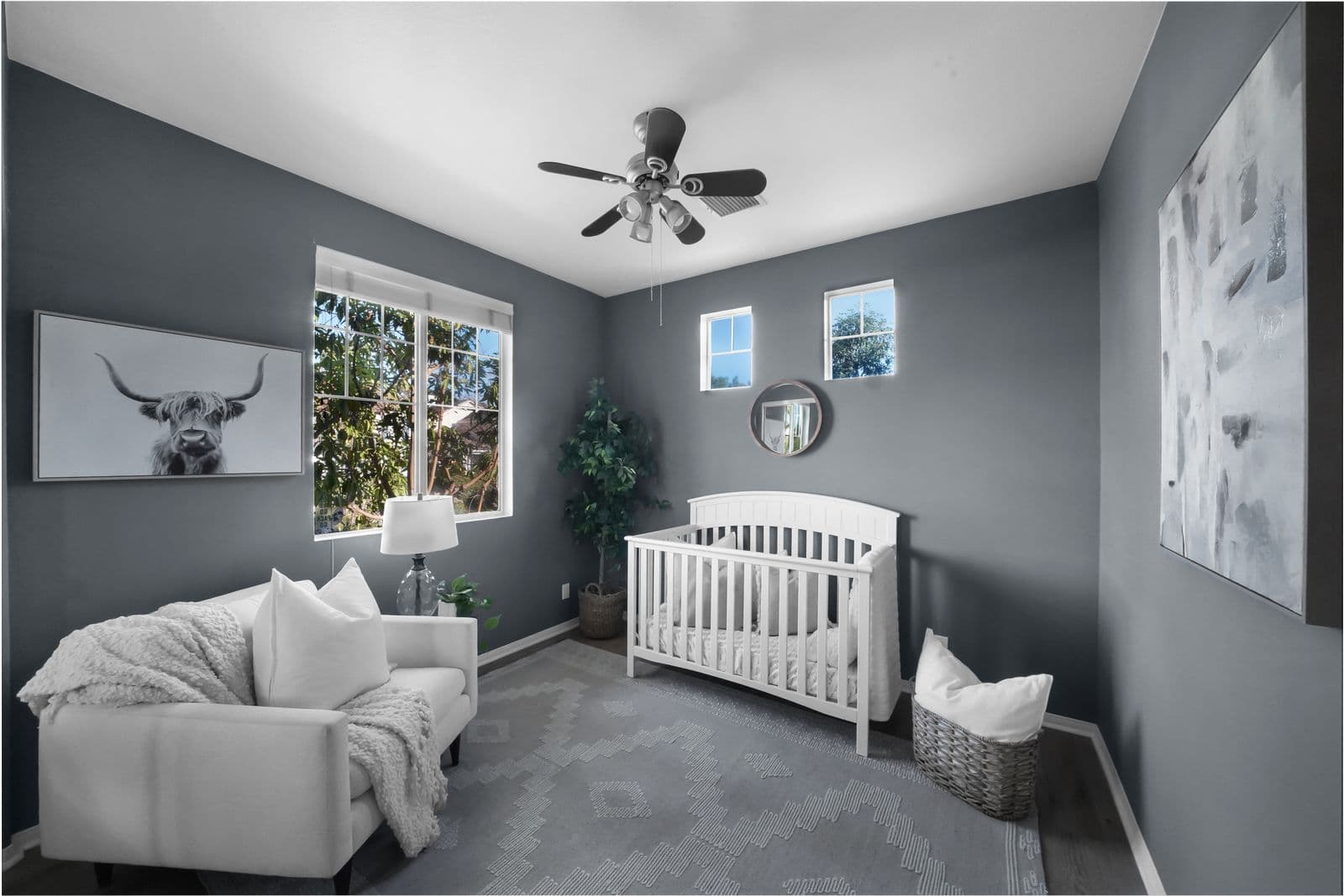
That is the shift in what a monitor is for. In a crib, the camera watches a child who cannot leave. In a bed, the risk is the wandering itself: stairs, a dresser drawer used as a step, a window, a bathroom cabinet. The same Stanford page lists stair gates, securing furniture against tip-over and latching drawers among the steps to take once a child can get out of bed. A camera aimed at the bed alone misses all of that, so the useful repositioning at this stage is a wider view that covers the door and the floor, or a simple door alarm in place of video. Our guide on moving from a crib to a bed covers the timing of that move in detail.
The cord rule carries over unchanged. A child who can walk to the camera has a much larger reach radius than one confined behind a rail, so the camera and its cord need to sit higher and further away than they did over the crib, not closer.
The softer signals that a monitor has done its job
Once the cord is managed, the wearable has aged out and the bed transition is behind you, the decision becomes the one most parents expected it to be all along: is this device still telling you anything? These are the signals worth weighing.
The monitor only reports what you would hear anyway. If the child's room is next to yours with the doors open, and every alert the monitor sends is a cry you heard through the wall first, the device has become a second notification for the same event.
The child comes to you. A preschooler who reliably gets out of bed and walks to your room when something is wrong has replaced the monitor's main job with a more accurate one.
The alerts have become the problem. Motion and sound alerts tuned for an infant trip on a toddler who talks in their sleep, rolls across the bed and sits up. If the app pings several times a night for nothing, the setting is wrong for the age, and turning sensitivity down or switching to audio only is the first step before removing it.
A renewal date arrives. Many connected cameras put history, clips and some alerts behind a paid plan. A renewal notice is a natural checkpoint: if the free tier covers the live view you still actually use, keep it there, and if you have stopped opening the app, the renewal is the moment to stop.
The child is old enough to object. Somewhere in the preschool years a camera in the bedroom becomes a privacy question as much as a safety one. A child who asks about it is old enough for the conversation, and a door alarm or an audio-only unit is often a fair compromise.
None of those is a rule. Some families keep an audio monitor running for years because of a medical condition, a large house or a child who sleepwalks, and nothing in the guidance argues against it. Anything medical, including whether a particular child needs monitoring at all, belongs with that child's pediatrician.
A step down before the full stop
Retiring a monitor does not have to be one step. A gradual exit tends to stick better and costs nothing.
First, drop the extras: turn off motion and breathing-style alerts and keep only sound. Second, move from video to audio, either by muting the picture in the app or by switching to a basic audio unit, which also removes the temptation to check a screen at 2am for no reason. Third, move the parent unit out of your bedroom and see whether anything you needed to know got missed over a couple of weeks. If nothing did, the device has answered the question for you.
Retiring a monitor properly
The last step is the one most often skipped, and it is the one with an actual safety consequence.
Unplug the camera and remove the cord from the room entirely, including any clips or adhesive channels along the wall. The CPSC staff letter's finding that cords fastened to walls came loose over time is the reason not to leave a run of dead cable behind a toddler bed. Take the bracket down too if it sits above a sleep space, since the same letter describes monitors falling from high mounts. Remove the camera from your account in the app and run the manufacturer's factory reset before passing it on, so a stranger does not inherit access to your account or your history. And before selling or handing down any monitor, search the brand and model against the CPSC recall database, because a recall notice can follow a product for years after the original owner stopped using it.
If another baby is coming, store the monitor with its manual and check the recall database again before it goes back up. The rule set for the new installation is the newborn one: three feet from every side of the crib, cord secured end to end, never on the rail. The baby monitor roundup covers what has changed on the market in the meantime, which after a two or three year gap is usually the app and the subscription terms.
Questions people actually ask
Is there an official age to stop using a baby monitor?
No. The AAP's safe sleep recommendations apply to the first year and recommend room sharing for at least the first six months, and the CPSC regulates where cords may sit, but neither sets an age to stop. Wearable sensors carry their own range, such as Owlet's stated 1 to 18 months and 6 to 30 pounds for the Dream Sock.
Should I keep the monitor after my toddler moves to a bed?
Usually yes, at least for a while. Stanford Medicine Children's Health suggests a baby monitor or a bell on the door once a child can get out of bed, because the risk shifts to the child wandering. Reposition the camera to see the door and floor, and keep its cord well out of reach.
Is it safe to leave an unused camera mounted on the wall?
Take it down along with its cord. A CPSC staff letter in April 2026 found that recent strangulation deaths involved monitors mounted high above cribs that fell, or wall-secured cords that came loose. A switched-off camera still carries the cord hazard.
When should a wearable sock monitor come off?
When the child passes the maker's stated range. For the Owlet Dream Sock, that is 18 months or 30 pounds, per Owlet's product page and FAQ. The AAP says there is no evidence consumer wearables reduce SIDS risk, so retiring one does not remove a proven protection.
What should I do with an old monitor before selling or reusing it?
Remove it from your app account, run the manufacturer's factory reset, and check the brand and model against the CPSC recall database. If it goes back up for a new baby, set it up from scratch with the cord at least three feet from every side of the crib.
Sources
- CPSC and JPMA, Safe and Sound Zone: Infants and Toddlers Can Strangle in Baby Monitor Cords, Publication 5066 (July 2012)
- CPSC staff letter to ASTM F15.68 on baby monitor cord strangulation, 23 April 2026
- CPSC, Two Strangulation Deaths Prompt Summer Infant to Recall Video Baby Monitors with Cords (2011)
- CPSC OnSafety, Baby Movement Monitor Recall: A Cord Issue (2013)
- HealthyChildren.org (American Academy of Pediatrics), How to Keep Your Sleeping Baby Safe: AAP Policy Explained
- Stanford Medicine Children's Health, Moving Your Toddler From Crib to Bed
- Owlet, Dream Sock product page
- Owlet, Frequently Asked Questions about FDA-Cleared Dream Sock
- CPSC recall database
As an Amazon Associate we earn from qualifying purchases. We earn a commission on some links, at no extra cost to you. It never changes which products we recommend or the order they appear in. Full disclosure

Who wrote this
Writer, standards and the recall record
Dan Whitfield writes the standards side of BabyGearSearch: what a certification actually covers, what the CPSC recall database says about a brand, and what the one-star reviews agree on six months in. He is not a clinician and does not write as one. His job is to read the standard rather than the marketing page, quote the real number, and name the limit the packaging skipped.
More from DanThe standard
How this guide was built
- Manufacturer specification sheets and warranty terms, read in full rather than summarised from a listing.
- The federal safety standard the product is certified to, plus anything NHTSA, the AAP or the CPSC has published on it.
- Owner reports at volume, including the one-star reviews, which is where failure modes live.
- Every price checked against the live listing on the date printed beside it.