Side-by-Side vs Tandem Double Stroller: The Fit Questions the Safety Standard Skips
One configuration is wider, one is longer, and the federal standard governing both tests neither dimension. Here is what to measure yourself.
- Editor, gear and the arithmetic of a small home
- Sep 6, 2026
- 8 min read

In this guide
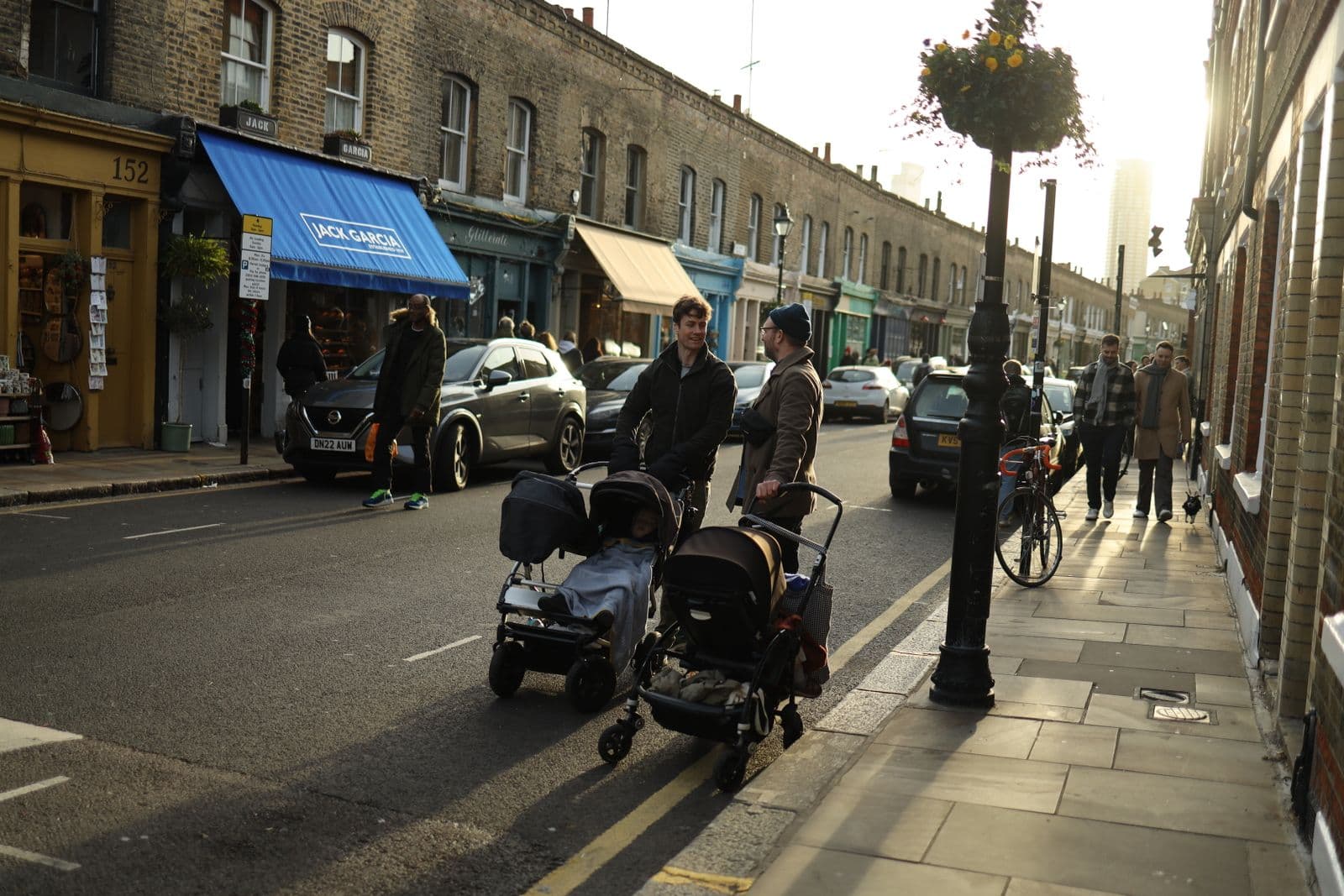
A double stroller comes in two basic shapes. Side-by-side puts both children in one row, at the same height, facing the same direction. Tandem stacks them front to back, one seat behind the other, usually at different heights. The choice between them gets framed as a personality question, which one "suits" your family, when it is actually a set of measurements, and the federal safety standard both configurations must meet has nothing to say about any of them.
What the standard actually certifies
Every stroller sold in the United States, single or double, has to comply with 16 CFR Part 1227, the Consumer Product Safety Commission's mandatory rule for carriages and strollers. That rule works by incorporating a private standard, ASTM F833, by reference. The specific version depends on manufacture date, with anything built after February 2022 held to F833-21.
What F833 tests is exhaustive on safety mechanics and silent on everything else. Per the CPSC's own business guidance, the requirements split into two groups: general requirements covering sharp points, small parts, wood durability and restraining systems, and performance requirements covering brake function, stability, impact resistance and wheel-detachment prevention. A double stroller loaded with two child-weight simulated loads has to pass the same stability and tip tests as a single. Manufacturers certify compliance in writing, on a Children's Product Certificate, before the product can legally ship.
None of that certificate says whether the thing fits through your front door, down the aisle at the pediatrician's office, or into the elevator in your building. Fit was simply never the standard's job. A frame can pass every clause of F833 and still be a daily fight to get in and out of your house, and the two double-stroller shapes fail at that in opposite directions.
Where side-by-side struggles: width
Putting two seats in a row means the stroller's overall width is close to double a single stroller's, minus whatever the frame designer manages to shave by narrowing each seat slightly and overlapping the wheelbases. That width is fixed the moment you choose the configuration. No amount of research into a specific model rescues a side-by-side double from being a wide object, because being a wide object is the entire mechanism.
The width shows up in three places that matter more than a showroom aisle ever will: your own front door, the aisle spacing in the stores you actually shop at, and the clear door width of the elevator in your building if you have one. Measure your boot before buying a stroller covers the same discipline for cargo space, and it applies here with a tape measure at the doorway instead of the car. Take the number of your narrowest regular doorway, subtract two inches for hands and moulding clearance, and that is the real ceiling on a side-by-side purchase, a figure the folded width on a spec sheet cannot tell you because that number describes storage rather than passage.
Where side-by-side wins is the row itself. Both children sit at the same height, can see each other, can see the same field of view ahead, and neither one is riding in the other's shadow. For twins, or for two children close enough in age that neither clearly outranks the other, that equality is usually the point of buying the configuration at all.
Where tandem struggles: sightline and recline
A tandem double keeps roughly a single stroller's width and adds length instead, which solves the doorway problem and creates a different one. The rear seat sits behind and, on most frames, slightly above or below the front seat rather than beside it, which means one child spends the walk looking at the back of a headrest instead of the street. Which child ends up in which seat becomes a real decision, one that gets revisited every few months as the children grow.
The other tandem-specific failure is recline conflict. Many tandem frames link the two seats' recline mechanisms to the frame in a way that limits how far the front seat can recline without pressing into the rear seat's space, or vice versa. A newborn who needs a near-flat recline in the front position can end up constraining what the older child's seat is allowed to do, and this is exactly the kind of interaction that a spec sheet lists as two separate recline-angle numbers without ever mentioning that the numbers are not fully independent of each other. Checking it properly means loading both seats together and watching what happens, since two separate lines in a spec table cannot show an interaction.
Tandem's genuine advantage is the length is close to a single stroller's, so it survives narrow doorways, single-file store aisles and standard elevators that would reject a side-by-side outright. It is also the more common shape for a newborn-and-older-sibling pairing, where the two seats are deliberately unequal: a bassinet or reclined infant position up front, a toddler seat behind, each sized for a different child.
The decision most people are actually making
Two kids close in age or twins, both needing an equivalent seat, in a house or a routine with wide doorways and no elevator: side-by-side is usually the right shape, and the width is a cost paid once at the point of purchase instead of a recurring one.
A newborn arriving with an older sibling still small enough to ride, in a building with a narrow hall, a compact car, or a lot of single-file aisles between you and daily errands: tandem is usually the right shape, and the unequal seats are a feature rather than a compromise, since the two children need different things anyway.
Neither configuration is safer than the other under F833. Both are held to identical stability and structural requirements regardless of shape, and neither has any bearing on whether an infant car seat can click into the front position, which is worth checking against the specific frame's adapter list rather than assumed from the category. What differs is entirely the geometry of the rooms, aisles and vehicles the stroller has to pass through every day, which is a question about your house, not about either product.
Check the specific model against the CPSC recall database before buying either configuration, new or used. Double-stroller recalls run to the same categories as singles, wheel detachment and frame hinges most often, and a two-child stroller failing in either mode is a bigger single event than a single-child one.
Related reading
Before shortlisting either shape, measure your boot before buying a stroller covers the cargo-space version of this same measure-first approach. The mechanism you will operate with two children aboard, one-handed, ideally, is broken down in stroller folds explained, and a folded double is close to never a cabin-bag fold regardless of configuration. If a car seat needs to click into either position, travel system versus buying separately works through the adapter question in more depth than a stroller spec sheet ever will. Our stroller roundup covers individual frames once the shape and fit questions here are settled.
Questions people actually ask
Is a side-by-side or a tandem double stroller safer?
Neither. Every stroller sold in the US, in either configuration, has to meet the same ASTM F833 stability, brake and structural requirements under 16 CFR Part 1227. The choice between them is a fit question, not a safety one.
Can a side-by-side double stroller fit through a standard door?
Sometimes, and it depends on the specific frame and your specific door. Measure your narrowest regular doorway and subtract about two inches for hand clearance, then compare that number against the stroller's published overall width, not its folded width.
Does a tandem stroller work for twins?
It can, but most tandem frames are built with two different seat positions in mind, one usually more upright or lower than the other, which suits a newborn-and-toddler pairing better than two children who need identical seats. Check whether the specific frame's two seats are actually equivalent before assuming a tandem works for twins.
Do double strollers have to pass extra crash or stability tests?
They are tested under the same ASTM F833 performance requirements as single strollers: stability, brake function, impact resistance and wheel-detachment prevention, loaded with two simulated child weights instead of one. There is no separate double-stroller standard.
Can I put an infant car seat in either seat of a double stroller?
Only if the specific frame lists an adapter for that specific car seat model. This varies by manufacturer and by seat position, and it is not something a stroller's general category (side-by-side or tandem) determines on its own.
Sources
As an Amazon Associate we earn from qualifying purchases. We earn a commission on some links, at no extra cost to you. It never changes which products we recommend or the order they appear in. Full disclosure

Who wrote this
Editor, gear and the arithmetic of a small home
Marisa Okonkwo edits BabyGearSearch and writes the hardware half of it: strollers, car seats, carriers and the furniture around them. She reads the specification sheet, the fit list and the returns policy in full before she reads a single review, because the difference between two apparently identical strollers is almost always a number one of them declines to publish.
More from MarisaThe standard
How this guide was built
- Manufacturer specification sheets and warranty terms, read in full rather than summarised from a listing.
- The federal safety standard the product is certified to, plus anything NHTSA, the AAP or the CPSC has published on it.
- Owner reports at volume, including the one-star reviews, which is where failure modes live.
- Every price checked against the live listing on the date printed beside it.