Can You Hang a Diaper Bag on a Stroller Handlebar? What the Manuals and the Standard Say
Stroller manuals warn that any load on the handlebar affects stability. Why the hook is the riskiest place for a bag, and where the weight should go.
- Editor, gear and the arithmetic of a small home
- Oct 6, 2026
- 13 min read
In this guide
Nearly every parent tries it at some point. The changing bag goes over the handlebar because it is right there, the basket is full of coats, and the stroller seems sturdy enough. Then the child climbs out at the park gate, the bag stays where it was, and the frame sits back on its rear wheels or goes over entirely.
The short answer is that the people who build strollers tell you not to. UPPAbaby's manual for the Minu V3 says it in one line: "Placing any load on the handlebars will affect the stability of the vehicle." Joovy's manual goes further and names the items: "Hanging purses, shopping bags, parcels, diaper bags or other accessory items from the handlebar or any other parts of the stroller may change the balance of the stroller and cause a hazardous unstable condition." KidsHealth, the Nemours children's health service, gives the same instruction in its stroller buying guide and adds a second reason, the strap.
This guide covers why the handlebar is the worst place on a stroller to put weight, what the federal standard does and does not test, how to read the load limits in your own manual, and what to do with the bag instead.
Why the handlebar is the worst place for weight
A stroller is stable for the same reason a wheelbarrow is: the load sits between the wheels. The child's seat is mounted roughly over the middle of the wheelbase, and the under-seat basket sits low and between the axles. Weight placed there pushes straight down and keeps all four wheels planted.
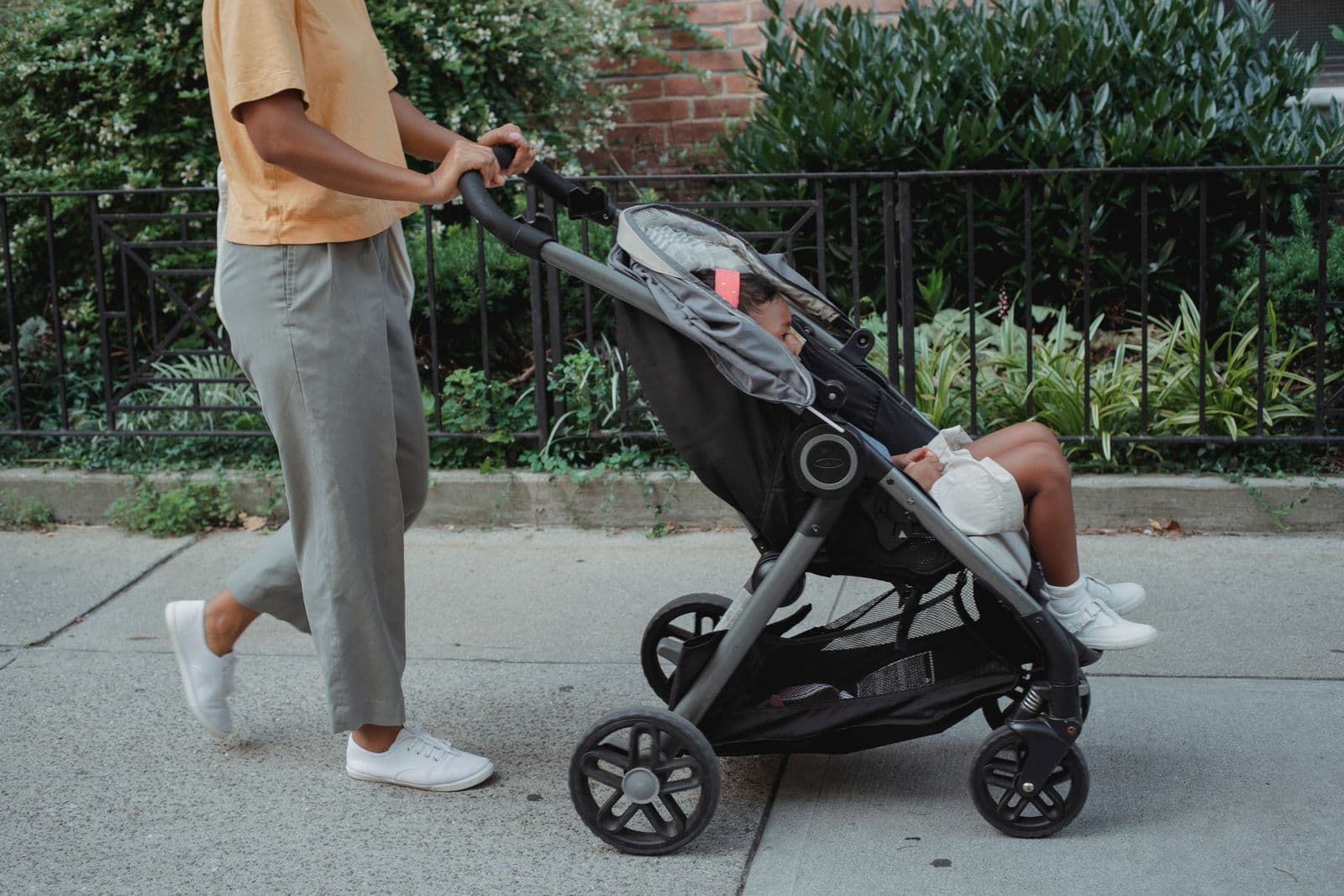
The handlebar is different. On almost every frame it sits up high and behind the rear axle, because that is where the person pushing has to stand. A bag hung there is a weight on the end of a lever, and the pivot point is the rear wheels. Anything that pulls the handle down or backward works to lift the front wheels off the ground.
While a child is in the seat, their weight sits in front of that pivot and largely cancels out a moderate bag. The danger arrives in three ordinary moments:
- The child gets out. Lift a toddler out of the seat with a full bag still on the handle and the counterweight has gone. This is the moment the frame tips backward, often onto the bag and the pavement, sometimes onto a younger sibling standing behind it.
- The child stands up or leans back. A child who stands on the footrest, climbs over the side or throws their weight back changes the balance mid-walk. KidsHealth's guidance on choosing a stroller says the frame "should resist tipping backward when you press lightly down on the handles", which is the same test in reverse: a bag is a hand that never lets go.
- The stroller meets a kerb or slope. Tilting the front wheels up to mount a kerb shifts more of the weight onto the rear axle. With a loaded handle, the tilt that the frame would normally recover from can carry on past the balance point.
A light frame makes all of this worse. An umbrella stroller or a cabin-sized travel frame has far less mass of its own to resist a heavy bag than a full-size frame does, so the same bag is a bigger share of the total weight. That is why the best strollers guide already warns against hanging a heavy changing bag off a lightweight frame, and why the bag that was harmless on a pram can tip a compact stroller.
There is a second hazard that has nothing to do with balance. A strap looped over a handle hangs into the space a child can reach. The KidsHealth guidance puts it bluntly: a baby "could get tangled in the straps and be strangled, or the weight of the bags could tip the stroller over."
What the federal standard tests, and what it leaves to you
Every stroller and carriage sold in the United States has to meet the federal safety standard at 16 CFR Part 1227, which incorporates ASTM F833-21, the consumer safety specification for carriages and strollers. The current version took effect on February 15, 2022. The CPSC's business guidance lists the performance requirements a frame has to pass, and stability is one of them, alongside parking brakes, static load, restraint systems and wheel detachment.
So a compliant stroller has been tested for stability. The catch is in what that test can know about. It checks the frame the manufacturer sold, set up and loaded the way the standard describes. It cannot know that someone will add a loaded bag to the handle, a coffee cup holder, a phone mount and a second bag on the other side. That is why the standard leaves the loading question to the label and the manual, and why every manual reviewed for this guide carries a load warning.
When the CPSC adopted the standard in 2014, its staff briefing gave a picture of what goes wrong with strollers in practice. Between January 1, 2008 and June 30, 2013, the agency had 1,297 reported stroller incidents involving children aged 4 or younger, including 4 deaths and 391 injuries. Stability and tip-over was one of the named hazard patterns, alongside wheels, locks, hinges and restraints. The staff's national estimate was 56,600 stroller-related injuries treated in US emergency departments between 2008 and 2012, and most of the newly reported cases in that hospital sample were falls: falls from the stroller, from climbing on it, from tip-over and from the stroller going down steps. Head (54%) and face (29%) were the most frequently injured body parts.
Canada has been explicit about the same gap. Its 2022 proposal to update the Carriages and Strollers Regulations, published in the Canada Gazette, would amend the stability test so that strollers with an adjustable backrest are tested in the most reclined as well as the most upright position, and would add "requirements and a test method for the stability of carriages and strollers with accessories." The same proposal requires every stroller to carry a warning that it "will become unstable if the manufacturer's recommended load is exceeded."
Stability failures are not hypothetical on compliant-looking products either. In April 2026, Health Canada announced a recall of the Mompush Velo, a lightweight one-step-fold travel stroller, after its sampling and evaluation program found it did not meet the country's stability requirements. Health Canada's notice says the strollers "may tip-over while in use, posing fall and injury hazards to children." The company had received no reports of incidents or injuries in Canada at the time. A frame that fails a stability test with no bag on it has no margin for one.
How to read the load limits in your manual
The useful numbers are almost never on the product page. They are in the warnings section at the front of the manual, and they differ more than most parents expect. Here is what three current UPPAbaby manuals and one Joovy manual say:
| Stroller (manual) | Storage basket limit | What the manual says about the handle |
|---|---|---|
| UPPAbaby Vista V2 | 30 lb (13.6 kg) | Unit may become unstable if a parcel bag or accessory other than one the manufacturer recommends is used or hung from it |
| UPPAbaby Cruz V3 | 30 lb (13.6 kg) | Parcels or accessory items placed on the unit may make it unstable |
| UPPAbaby Minu V3 | 20 lb (9.1 kg) | Any load on the handlebars affects stability. Attach only one weight-bearing accessory to the handlebar at a time |
| Joovy ScooterX2 (807X) | 5 lb (2.27 kg) | Any load attached to the handle affects stability. Names diaper bags, purses and shopping bags specifically |
Three things stand out.
The basket limit is the load limit. Each of these manuals gives a maximum weight for the storage basket and no figure at all for the handlebar. That is not an oversight. The basket is the place the frame was designed to carry weight, and the handle is not. A 30-pound basket rating on a full-size frame does not mean the handle can take a share of that 30 pounds.
The compact frame has the tighter rules. The Minu V3 is UPPAbaby's travel stroller and has the lowest basket limit of the three, 20 pounds. Its manual is also the only one of the three to limit handlebar accessories to one weight-bearing item at a time, and it adds a configuration rule: when using accessories that attach to the handle, keep the toddler seat upright and an infant car seat parent-facing. Both read as ways of keeping weight forward of the rear axle while something hangs from the handle.
"Manufacturer recommended" is doing work. The Vista and Cruz manuals tie their warnings to a parcel bag, accessory or rack "other than that recommended by the manufacturer." A brand-made organiser or cup holder designed for that frame has been accounted for by the people who know its geometry. A universal hook, a clip-on bag rail from another brand or a full changing bag on a carabiner has not.
If your stroller is not one of these, look for the same three items in its manual: the basket maximum, the line about loads on the handle, and any limit on the number of handle accessories. If the manual is lost, most brands publish a PDF on their support pages, and the model number is on the label the federal rule requires to be fixed to the frame.
Where the bag should go instead
The goal is to keep the weight low and between the wheels, and to keep straps out of a child's reach.
- Use the basket first. Put the heaviest things in it: the changing bag itself, water bottles, a laptop, shopping. Stay under the basket limit in the manual. A basket that will not take the bag is the signal that the bag is too big for this frame, not that the handle should take the overflow.
- Carry the bag on your body. A backpack-style changing bag or a cross-body bag moves the weight onto the adult, where it cannot tip anything. It is also the only option on a small travel frame whose basket holds a coat and little else.
- Keep handle accessories light and brand-approved. A cup holder or a small organiser made for your frame is within what the manufacturer allowed for. A phone, keys and a drink are a different load from a bag with a bottle, a spare outfit and a full pack of wipes.
- Take the bag off before the child gets out. If something is on the handle, unload it first, set the parking brake, and only then lift the child out. Every UPPAbaby and Joovy manual reviewed here asks for the brake to be engaged while a child is taken in or out.
- Never let a child hang from the handle or stand on the footrest. The Joovy manual warns that letting a child step onto or sit on the leg support may cause the stroller to tip over. An older sibling swinging on the handlebar is the same lever as a heavy bag, with more force behind it.
If you regularly carry more than the basket can hold, that is worth weighing when you choose a frame. Basket capacity and frame weight both belong on the shortlist alongside the fold and the boot, and the boot measuring guide and fold types explainer cover the other two numbers that decide most stroller purchases.
Double strollers, joggers and the empty seat
A double stroller with one child in it is the single-child problem with more frame. If the occupied seat is the rear one on a tandem, the child's weight sits closer to the rear axle than it would in the front seat, so it does less to balance a bag on the handle. The trade-offs between the two double layouts are set out in side-by-side versus tandem.
Jogging strollers have a long wheelbase and a large front wheel, but they are pushed faster and over rougher ground, where a swinging bag pulls on the frame with every stride. The age limits for running with one are in the jogging stroller guide. The loading rule is the same: basket or body, not the handle.
Questions people actually ask
Is it safe to hang a diaper bag on a stroller handle?
Stroller manufacturers say not to. UPPAbaby's Minu V3 manual states that placing any load on the handlebars will affect the stability of the stroller, and Joovy's manual names diaper bags specifically as items that can cause a hazardous unstable condition. KidsHealth gives the same advice and notes a strangulation risk from the straps.
Why do strollers tip backward when you take the child out?
The handlebar sits behind the rear wheels, so a bag hanging from it acts as a lever pulling the front of the frame up. While a child is seated, their weight sits forward and balances it. Remove the child and the counterweight goes, which is why the bag should come off first.
How much weight can a stroller basket hold?
It depends on the model and is printed in the manual's warnings. Among current manuals, the UPPAbaby Vista V2 and Cruz V3 baskets are rated to 30 pounds, the travel-sized Minu V3 to 20 pounds, and the Joovy ScooterX2 to 5 pounds.
Are stroller hooks and clips safe to use?
Only within the manufacturer's instructions. The Vista V2 and Cruz V3 manuals warn that a parcel bag or accessory other than one the manufacturer recommends may make the stroller unstable. A light brand-made cup holder or organiser is different from a universal hook carrying a full changing bag.
Does the federal stroller standard test for tip-over?
Yes. The mandatory standard at 16 CFR Part 1227, which incorporates ASTM F833-21, includes stability requirements. It tests the stroller as sold, not with extra bags or third-party accessories added, which is why manuals carry a separate load warning.
Sources
- CPSC, Carriages and Strollers Business Guidance
- eCFR, 16 CFR Part 1227, Safety Standard for Carriages and Strollers
- Federal Register, Safety Standard for Carriages and Strollers, direct final rule, 86 FR 64345, November 18, 2021
- CPSC staff briefing, Final Rule: Safety Standard for Carriages and Strollers, January 2014
- Canada Gazette, Part I, Vol. 156, No. 24, Carriages and Strollers Regulations (proposed), June 2022
- Health Canada, Mompush Velo stroller recalled due to tip-over, fall and injury hazards
- KidsHealth (Nemours), Choosing Safe Baby Products: Strollers
- UPPAbaby, Vista V2 product manual
- UPPAbaby, Cruz V3 product manual
- UPPAbaby, Minu V3 product manual
- Joovy, ScooterX2 (807X) instruction manual
As an Amazon Associate we earn from qualifying purchases. We earn a commission on some links, at no extra cost to you. It never changes which products we recommend or the order they appear in. Full disclosure
Who wrote this
Editor, gear and the arithmetic of a small home
Marisa Okonkwo edits BabyGearSearch and writes the hardware half of it: strollers, car seats, carriers and the furniture around them. She reads the specification sheet, the fit list and the returns policy in full before she reads a single review, because the difference between two apparently identical strollers is almost always a number one of them declines to publish.
More from MarisaThe standard
How this guide was built
- Manufacturer specification sheets and warranty terms, read in full rather than summarised from a listing.
- The federal safety standard the product is certified to, plus anything NHTSA, the AAP or the CPSC has published on it.
- Owner reports at volume, including the one-star reviews, which is where failure modes live.
- Every price checked against the live listing on the date printed beside it.