The Best Diaper Pails, Judged on the Refill You Will Be Buying for Two Years
Four diaper pails ranked on the refill system, the per-diaper cost, how many diapers a load holds, and where the pail belongs in the room.
- Editor, gear and the arithmetic of a small home
- Oct 2, 2026
- 14 min read
4 products compared
In this guide
A diaper pail is the one piece of nursery equipment you pay for twice. The first payment is the pail, somewhere between sixty and eighty dollars for everything in this guide. The second is the refill, and for a sealed-refill pail it keeps arriving for as long as there are diapers in the house. It is the number almost nobody looks at before checkout.
So the four pails below are ranked on the refill first and the pail second. What separates them is what you have to keep buying, what it costs per diaper, and how often you are carrying a bag to the bin.
What actually decides this
There are three refill systems, and the pail locks you into one of them. A plain-bag pail takes an ordinary kitchen trash bag. A ring or cassette pail feeds a continuous tube of film that seals each diaper off from the last. A roll-bag pail uses a branded roll of individual bags that you tie off one at a time. The first is the cheapest to run and relies on the pail's own seal. The second and third wrap the diapers in branded film, and on Munchkin's published prices the ring is the cheaper of those two per diaper.
Two capacity numbers get confused, so read them separately. The Ubbi and the Diaper Genie Platinum publish how many newborn diapers the pail holds before the bag comes out, 55 and 47. The ring pails publish how many diapers one refill lasts for, 270 for the Diaper Genie Complete and 272 for a Munchkin ring. The first figure tells you how often you carry a bag out. The second tells you how often you reorder. A family in a third-floor walk-up and a family with a bin by the back door should weigh them differently.
Hands-free matters more than it sounds. Three of the four open on a foot pedal. That is not a luxury feature. It is the difference between keeping one hand on a baby on the changing surface and taking it off to open a lid. The fourth opens by hand, and the trade is a cheaper refill for a two-handed moment.
Steel or plastic is a real choice, not a finish. Ubbi's own product page argues that stainless steel does not absorb smell the way plastic does, and two of the four pails here are steel. A plastic pail is lighter and usually cheaper. The seal at the lid is the other half of odor control, and every pail here names its own: a silicone ring, a self-sealing lid, or clamps.
The picks
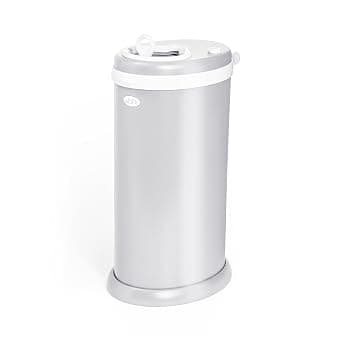
$67.77
Price checked Oct 2, 2026
Ubbi Stainless Steel Diaper Pail, Gray
The Ubbi is the pail for anyone who resents paying a subscription to throw things away. It takes any standard kitchen trash bag, so the refill is whatever is already under the sink, and the per-diaper cost is close to nothing. The body is powder-coated stainless steel with a silicone seal ring, which is what Ubbi relies on for odor control in place of a sealed film. The trade is capacity and convenience: Ubbi rates it at about 55 newborn diapers or roughly 20 larger ones, it opens by hand on a sliding lid rather than a foot pedal, and each bag is an ordinary bag rather than a sealed tube. Ubbi backs it with a 3-year warranty against manufacturing defects.
We may earn a commission on this link. It never changes the ranking.
- Refill
- Any standard kitchen trash bag
- Capacity
- About 55 newborn or 20 larger diapers
- Size
- 8.4" W x 19.5" H x 11.4" D
- Body
- Powder-coated stainless steel
What works
- Takes any standard kitchen trash bag, so there is no branded refill to buy for two years
- Powder-coated stainless steel body with a silicone seal ring
- Childproof lid lock, stated on both the Ubbi page and the listing
- Three-year warranty against manufacturing defects
What to know
- Opens by hand on a sliding lid, so it is a two-handed moment at the changing table
- About 55 newborn diapers before the bag comes out, and far fewer larger ones
- An ordinary bag is not a sealed film, so the seal ring does all the odor work
- Gray costs $10 more than white at Ubbi's own list price
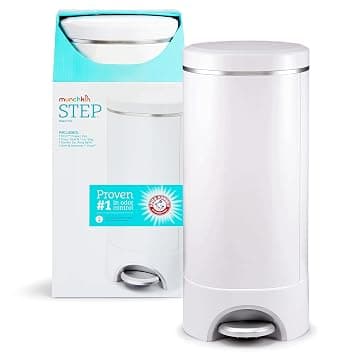
$70.99
Price checked Oct 2, 2026
Munchkin STEP Diaper Pail Powered by Arm & Hammer
The STEP is the pail that does not make you choose a refill system at purchase. Munchkin describes it as a universal refill system: it takes Arm & Hammer refill rings, a continuous film tube rated for up to 272 newborn diapers per ring, or Snap, Seal & Toss bags, individual bags that hold up to 30 newborn diapers each. At Munchkin's own prices the ring works out to about 2.2 cents per newborn diaper on the 8-pack and the bags to about 3.8 cents, so the ring is the cheaper sealed option by a clear margin. The lid is self-sealing, and Munchkin says the bag stays sealed when the lid is opened. A lavender-scented baking soda cartridge sits in the lid as a second line of odor control, and it is a third consumable to remember.
We may earn a commission on this link. It never changes the ranking.
- Refill
- Arm & Hammer rings or Snap, Seal & Toss bags
- Refill lasts
- Up to 272 newborn diapers per ring
- Size
- 27" H x 12" W x 11" D
- Opening
- Foot pedal
What works
- Takes refill rings or individual bags, so you can switch systems without replacing the pail
- One refill ring lasts for up to 272 newborn diapers, the longest-rated refill in this guide
- Self-sealing lid keeps the bag sealed when the lid is open
- Foot pedal, so one hand stays on the baby
What to know
- Plastic body rather than steel
- The baking soda cartridge is a third thing to buy and replace
- At 27 inches tall it is a full-height pail that will not tuck under a changing table shelf
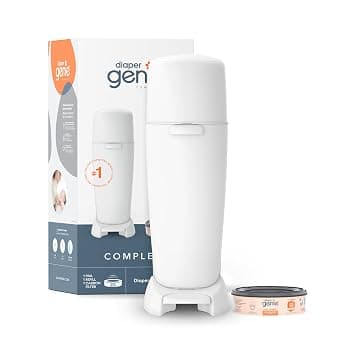
$62.48
Price checked Oct 2, 2026
Diaper Genie Complete Diaper Pail, White
The case for the Diaper Genie Complete is the seal. Each refill is a continuous multi-layer film that Diaper Genie rates at up to 270 newborn diapers, closed by what the brand calls double Air-Tite clamps, with a carbon filter. It opens on a foot pedal. It is the cheapest pail here at today's price. The useful detail for running cost is that Munchkin lists the Diaper Genie Complete as compatible with its Arm & Hammer refill rings, so the Complete is not locked to one brand of refill. The carbon filter is a separate consumable on top of the film.
We may earn a commission on this link. It never changes the ranking.
- Refill
- Continuous film ring, up to 270 newborn diapers
- Odor control
- Double clamps plus carbon filter
- Opening
- Foot pedal
- Body
- Plastic
What works
- Sealed multi-layer film refill rated at up to 270 newborn diapers
- Foot pedal for hands-free use
- Accepts Munchkin Arm & Hammer refill rings as well as its own, per Munchkin's compatibility list
- Lowest pail price of the four at the time of checking
What to know
- Plastic body
- The carbon filter is a second consumable alongside the film
- Diaper Genie's own site does not display a price, so there is no brand figure to check a deal against
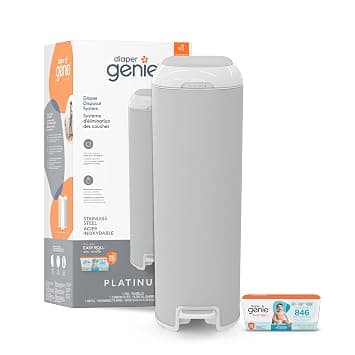
$75.00
Price checked Oct 2, 2026
Diaper Genie Platinum Pail, Grey
The Platinum is the pail that answers the Ubbi's one real weakness. It is stainless steel, like the Ubbi, and it opens on a foot pedal, unlike the Ubbi. The refill is a Diaper Genie Easy Roll, a roll of individual bags rather than a continuous film, and the listing rates one roll at 18 bags that can last up to 5 months. The pail holds up to 47 newborn diapers per bag, fewer than the Ubbi's 55, which means more frequent bag changes in the newborn months and a lighter bag each time. It is the most expensive pail of the four, and the Easy Roll is a branded consumable with no second source named on either brand's page.
We may earn a commission on this link. It never changes the ranking.
- Refill
- Easy Roll, 18 bags per roll
- Capacity
- Up to 47 newborn diapers per bag
- Size
- 12.9" L x 9.1" W x 27" H
- Body
- Stainless steel
What works
- Stainless steel body rather than plastic
- Foot pedal, so it is hands-free where the Ubbi is not
- Odor-locking clamps over each bag
- Small, light bags are easier to carry down stairs
What to know
- Holds up to 47 newborn diapers per bag, fewer than the Ubbi
- Easy Roll refills are branded and single-source
- Most expensive pail of the four
The comparison, in one table
| Pail | Price | Refill type | Capacity | Hands-free |
|---|---|---|---|---|
| Ubbi Steel | $67.77 | Any kitchen trash bag | About 55 newborn in the pail | No, sliding lid |
| Munchkin STEP | $70.99 | Rings or individual bags | Ring lasts up to 272 newborn | Yes, pedal |
| Diaper Genie Complete | $62.48 | Continuous film ring | Refill lasts up to 270 newborn | Yes, pedal |
| Diaper Genie Platinum | $75.00 | Easy Roll bags | Up to 47 newborn in the pail | Yes, pedal |
The refill arithmetic
Munchkin publishes both of its refill prices, which makes the STEP the cleanest example of the arithmetic. An 8-pack of Arm & Hammer refill rings is listed at $47.99 on sale, down from $63.12, and each ring holds up to 272 newborn diapers. That is 2,176 diapers for $47.99, or about 2.2 cents a diaper. At the full $63.12 it is about 2.9 cents. The Snap, Seal & Toss bags are $6.79 for a 6-pack that holds up to 180 newborn diapers, or about 3.8 cents a diaper. Per thousand newborn diapers, that is roughly $22 on rings at the sale price against roughly $38 on bags.
The Ubbi's refill is a kitchen trash bag, which most households already buy, so its marginal cost is a fraction of a cent a diaper. That is the whole case for it, and it is a strong one. The price of that saving is a bag that is not individually sealed, which is why the steel body and the silicone seal ring are doing the work a film does in the other pails.
The Diaper Genie Complete's own refill price is not displayed on Diaper Genie's site, so we do not put a per-diaper figure on it here. What is published is Munchkin's compatibility list, which names the Diaper Genie Essentials, Complete, Elite and II as pails its refill rings fit. If that holds for your unit, the Complete runs on the same 2.2-cent arithmetic as the STEP.
Two things the per-diaper figure does not capture. Capacity ratings are given in newborn diapers, and larger sizes fill a load far faster: Ubbi's own figure is 55 newborn diapers or about 20 larger ones in the same pail. And a sealed pail still has to be emptied: a long-lasting ring means fewer reorders, not fewer trips to the bin.
Who each one is wrong for
The Ubbi is wrong for anyone who needs both hands free at the changing table, because its lid opens by hand. It is also wrong for a household that would rather empty the pail once a week than twice, given a load of about 55 newborn diapers.
The Munchkin STEP is wrong for a buyer who wants fewer consumables, since it adds a baking soda cartridge to whichever refill you choose. It is also wrong for a narrow gap beside a dresser at 12 inches wide and 27 inches tall.
The Diaper Genie Complete is wrong for anyone who wants a steel body, and for anyone who wants a published brand list price to check a deal against, since the brand site does not display one.
The Diaper Genie Platinum is wrong for a household that wants the fewest bag changes, because at up to 47 newborn diapers per bag it holds less than the Ubbi. It suits the household carrying every bag down a flight of stairs.
Where the pail goes, and what the federal rules do not cover
The changing table a pail stands beside is a regulated product. The CPSC codifies the safety rule for baby changing products at 16 CFR part 1235, which incorporates the ASTM F2388 standard and covers changing tables, add-on changing units, changing table accessories and contoured changing pads, with requirements for stability, barriers and restraint systems. A diaper pail is not on that list. Nothing in the rule speaks to the pail, so where it goes and what it holds are decisions left entirely to you.
Two findings from CPSC staff are worth knowing before you pick the spot. In its nursery products report covering children younger than five, CPSC staff estimated emergency-department-treated injuries associated with changing tables at 2,700 in 2017 and 4,200 in 2018, an increase the report describes as statistically significant. A foot pedal is the feature that lets a hand stay on the baby while a diaper goes in the pail, and that is the practical reason three of the four pails here have one.
The same report describes crib deaths in which the product was not at fault but its surroundings were, including suffocations from plastic bags located in close proximity to the crib. A diaper pail is a container of plastic bags, and its spare refills and bag rolls are more of them. Put the pail and its refills on the changing side of the room, not beside the crib, and store spare bags in a closed drawer or a high shelf.
The anchoring question for the dresser the pail sits next to is covered in anchoring nursery furniture under the STURDY Act, and the dresser-or-table decision that decides where the changing station goes in the first place is in changing table or dresser topper. The same CPSC report flags cords and strings near a sleep space for the same reason it flags bags, and the window version of that is covered in window blind cords in a nursery. The rest of the nursery hardware, starting with the machine that runs all night across the room, is in the best sound machines.
Questions people actually ask
Do I need a diaper pail at all?
No. A lidded kitchen bin and a habit of taking the bag out daily does the same job, and the Ubbi is essentially a better-sealed version of that idea. A pail earns its place when the outdoor bin is far away, when you want a foot pedal at the changing table, or when you would rather empty it a few times a week than daily.
Which refill system is cheapest?
A plain-bag pail like the Ubbi, because the refill is an ordinary kitchen trash bag. Among sealed refills, Munchkin's own prices put its Arm & Hammer refill rings at about 2.2 cents per newborn diaper on the 8-pack sale price, against about 3.8 cents for its Snap, Seal & Toss bags.
Can I use other brands' refills in a Diaper Genie?
Munchkin lists the Diaper Genie Essentials, Complete, Elite and II as compatible with its Arm & Hammer refill rings, and lists those rings as not compatible with its own Cycloseal Pro pails. Check the refill packaging against your exact model before buying in bulk.
How many diapers does a pail really hold?
Fewer than the box suggests once a baby moves out of newborn sizes. Ratings are given in newborn diapers. Ubbi's figure for its pail is about 55 newborn diapers or roughly 20 larger ones, which shows how fast the number falls as diapers get bigger.
Sources
- Ubbi stainless steel diaper pail product page (ubbiworld.com)
- Munchkin Step Diaper Pail product page (munchkin.com)
- Munchkin Arm & Hammer Diaper Pail Refill Rings product page (munchkin.com)
- Munchkin Arm & Hammer Snap, Seal & Toss Bag Refills product page (munchkin.com)
- Diaper Genie Complete Pail product page (diapergenie.com)
- Diaper Genie Platinum Pail product page (diapergenie.com)
- CPSC, Baby Changing Products Business Guidance, 16 CFR part 1235
- CPSC staff, Injuries and Deaths Associated with Nursery Products Among Children Younger than Age Five, December 2019
- CPSC recall database
As an Amazon Associate we earn from qualifying purchases. We earn a commission on some links, at no extra cost to you. It never changes which products we recommend or the order they appear in. Full disclosure

Who wrote this
Editor, gear and the arithmetic of a small home
Marisa Okonkwo edits BabyGearSearch and writes the hardware half of it: strollers, car seats, carriers and the furniture around them. She reads the specification sheet, the fit list and the returns policy in full before she reads a single review, because the difference between two apparently identical strollers is almost always a number one of them declines to publish.
More from MarisaThe standard
How this guide was built
- Manufacturer specification sheets and warranty terms, read in full rather than summarised from a listing.
- The federal safety standard the product is certified to, plus anything NHTSA, the AAP or the CPSC has published on it.
- Owner reports at volume, including the one-star reviews, which is where failure modes live.
- Every price checked against the live listing on the date printed beside it.