Babywearing in Cold Weather: The Coat, the Cover and the Airway
How to keep a worn baby warm without loosening the carrier or hiding the face: what goes over, what goes under, and the signs of too cold and too hot.
- Editor, gear and the arithmetic of a small home
- Oct 17, 2026
- 14 min read
In this guide
- Why cold changes the carrier question
- The coat goes over the carrier, not under it
- Keeping the face clear
- Dressing the baby for stillness
- Overheating swings the other way
- Covers, coats and what the carrier's certification covers
- When the baby falls asleep
- A baby with a cold
- Where this fits in the carrier cluster
- Sources
A carrier looks like the warmest way to take a baby outside in cold weather, since two bodies share heat through one panel of fabric. The problems start with the instinct to add things: a thicker suit on the baby, a puffy coat on the adult, a hood, a scarf, a blanket tucked over the top. Each of those additions works against one of the checks that keep a worn baby safe.
The checks do not change with the weather, but cold makes them easier to fail without noticing. A carrier that cannot be pulled snug over a snowsuit is a loose carrier. A coat zipped to the adult's chin can cover a newborn's mouth. Even a baby sitting still against a warm chest can have cold feet poking out at the bottom of the panel, and a baby who is fine on the walk can overheat ten minutes later on a heated bus. This guide takes those failures one at a time.
Why cold changes the carrier question
The Canadian Paediatric Society's winter safety handout puts the core problem in one line: babies need extra care and bundling "because they cannot generate body heat or tell you if they are cold the way an older child can." Its frostbite handout adds the part that matters most for babywearing, which is that babies and toddlers are more at risk "since they don't move as much." A baby in a carrier is close to the definition of not moving much. The torso is warm against the wearer, but the hands, the feet, the ears and the cheeks are at the edges of the shared heat.
Against that sits the airway. The CPSC's 2010 warning on sling carriers described two suffocation hazards: fabric pressing against an infant's nose and mouth, and a curled position that bends the chin toward the chest and restricts the airway. Its single recommendation for the wearer was that the infant's face "is not covered and is visible at all times." Every piece of cold-weather gear that goes near a carrier has to be judged against that sentence first and against warmth second.
So the job in cold weather is narrow. Keep the extremities warm, keep the carrier tight, and keep everything you add below the baby's chin. The TICKS checklist (tight, in view at all times, close enough to kiss, keep the chin off the chest, supported back) is the test to run after every layer goes on.
The coat goes over the carrier, not under it
Start with the adult. A thick down or synthetic coat worn under the carrier puts a layer of compressible loft between the straps and the wearer's body. The straps can be cinched until they feel firm, but what feels firm is the coat, and the carrier itself is sitting further from the wearer's torso than its maker designed it to. That is the first letter of TICKS failing quietly. A loose carrier lets the baby slump, and slumping is the posture that brings the chin down toward the chest.
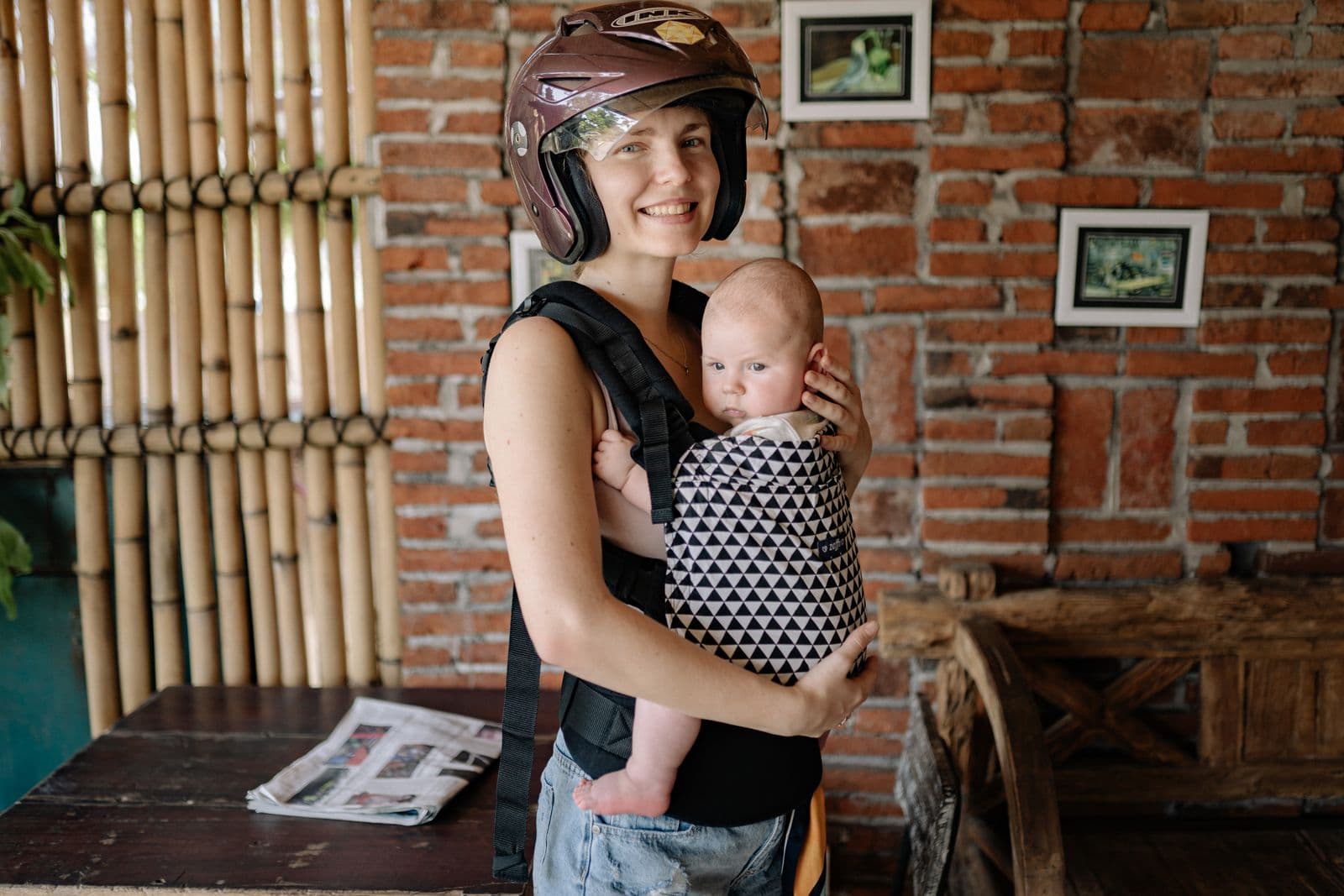
The fix is to put the carrier on over thin layers, adjust it to the fit you would use indoors, and put the outer coat on over both of you. A coat cut for one adult rarely closes around two people, which leaves three options. An oversized coat, often an inexpensive one bought a size or two up, can close over the carrier. A zip-in babywearing panel or extender, sold for a number of maternity and outdoor coats, widens the front of a coat the wearer already owns. A purpose-made babywearing jacket has the extension built in. The extension panel should leave the baby's head fully out, with the coat's top edge sitting below the baby's chin rather than at the adult's chin.
The same logic applies to the baby, with one difference. A puffy snowsuit inside the carrier panel does to the carrier's fit what a puffy coat does to the straps, and it also changes how the baby sits in the seat of the panel. The better pattern is a thinner fleece or wool layer on the baby and the coat or cover over the outside. This mirrors the reasoning in winter coats and car seats, though the stakes differ: a carrier is not put through a crash test, so the concern here is fit and the airway rather than harness slack in a collision.
Keeping the face clear
Most cold-weather airway risk comes from well-meant coverage, mostly from three items.
The coat collar. A zip that closes to the wearer's chin can rise above a small baby's face, especially a newborn sitting high on the chest. Close the coat to a point that leaves the baby's whole face, and the space in front of the mouth, open to the air. If that leaves a gap at the adult's neck, a separate neck warmer for the adult closes it without involving the baby.
Hoods and scarves. The baby's hood should frame the face rather than fall forward over it. A scarf on the adult can drift down over a baby in a front carry during a walk, so tuck it inside the coat or leave it at home. A scarf on the baby adds loose fabric right beside the face, which is the opposite of what the CPSC asks for.
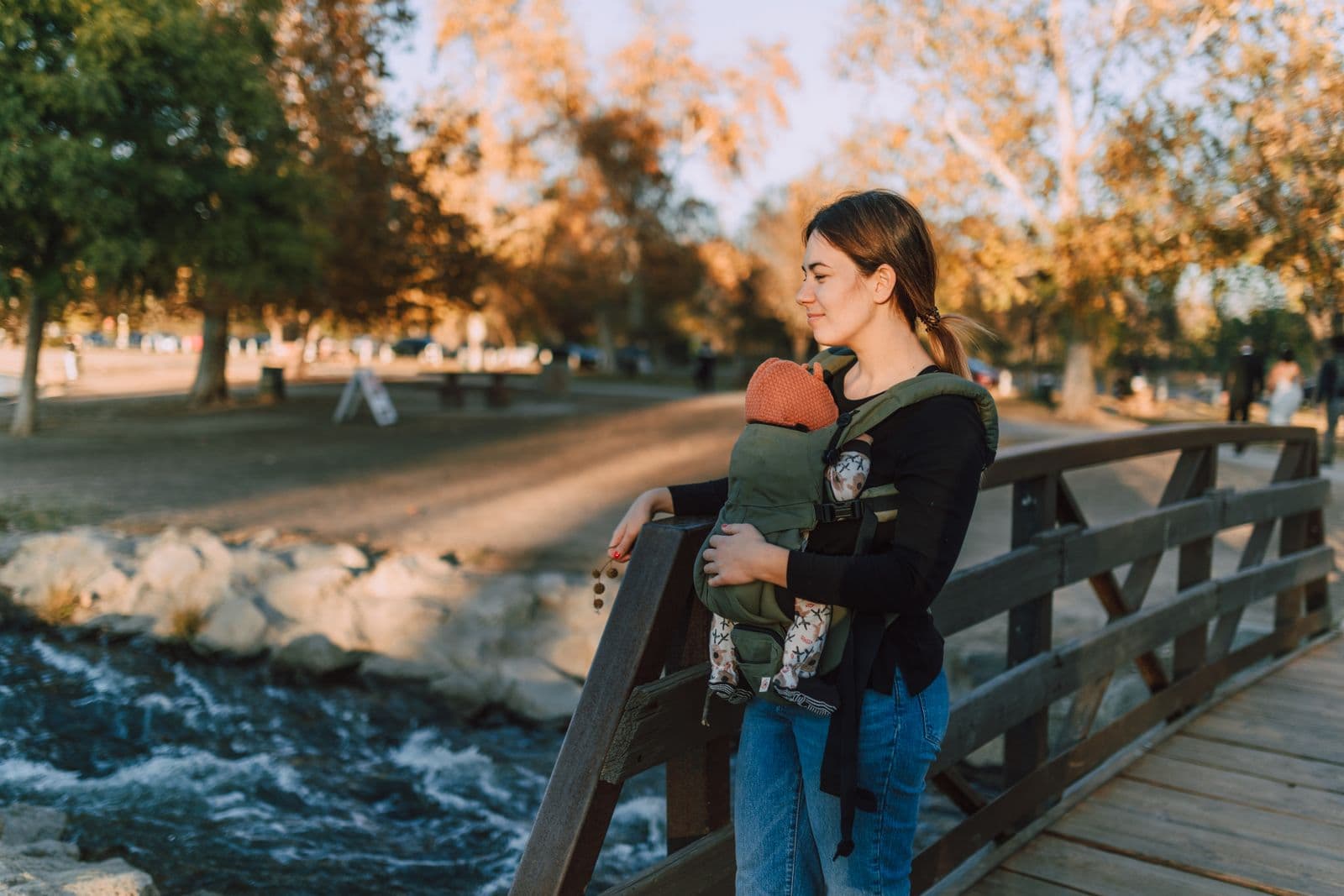
Blankets and covers. A blanket thrown over the baby and the carrier is the one item that most directly contradicts the CPSC's "visible at all times" line. A fitted carrier cover from a babywearing brand is a better design than a loose blanket. The test for it is the same, though: the opening has to sit below the baby's face, and the wearer has to be able to see the face by glancing down without lifting anything.
A practical habit helps here. Every time a layer goes on or is adjusted, look down and run the two TICKS checks that cold weather threatens most: can you see the face, and is there at least a finger's width between the chin and the chest? If a hood, a collar or a cover blocks either check, it is in the wrong place.
Dressing the baby for stillness
The Canadian Paediatric Society's guidance for children in the cold is to dress in layers that come on and off easily, to cover as much skin as possible, to keep the ears covered, and to prefer mittens over gloves. For a baby in a carrier, that translates into four specific places to look.
Feet and legs. In most front carries the baby's legs come out of the bottom corners of the panel, and the motion of walking pulls trouser legs up. Bare shins and ankles are the most commonly exposed skin in a babywearing walk. Footed fleece, or thick socks over leggings, with booties over the top, closes the gap. Leg warmers that run from the ankle to above the knee stay in place better than trousers alone.
Hands. A baby's hands often sit at the edge of the panel or outside it. Mittens that cover the wrist, or a suit with fold-over cuffs, keep them covered.
Head and ears. A hat that covers the ears matters outside. The CPS notes that ears "can be easily frostbitten," and a worn baby's head is above the warmth of the shared panel.
Cheeks. The face has to stay uncovered, so on the coldest days exposure time, not more fabric, is the lever.
The CPS frostbite handout gives two numbers. It advises reducing the time children spend outside when the temperature falls to -15°C (5°F) or colder, with or without wind chill. It also advises considering keeping children indoors when the temperature or the wind chill is reported at -27°C (-16°F) or lower, the point at which exposed skin begins to freeze. Those figures are written for children generally, so a baby who cannot move or complain is a reason to treat them as upper limits rather than targets.
The same handout describes what to look for. Skin first turns red and swollen, then, if not warmed, looks grey and tingles, and frozen skin is shiny, white and has no feeling. Its instruction is to seek medical advice immediately if a child's skin is white, waxy or numb, and not to rub frostbitten skin. If any of those signs appear, that is a call for a clinician rather than something to manage at home.
Overheating swings the other way
The mistake that follows bundling is forgetting to undo it. A baby dressed for a winter walk can be too warm minutes after entering a shop, a heated car or a bus.
The NICHD's Safe to Sleep guidance is direct about why this matters: a baby can overheat from too many layers for the room temperature, which it calls overbundling, and "overheated babies are at higher risk for SIDS and heat-related death." It also says to take a baby's hat off indoors, because wearing it inside can make the baby too hot. The Australian safe-sleep charity Red Nose goes further, explaining that babies release excess heat through the head and face and advising that hats, bonnets and hooded clothing come off as soon as the baby comes indoors or enters a warm car, bus or train.
For a worn baby, that means a short routine every time you come inside. Open the outer coat or remove the cover, take the hat off, and check the back of the baby's neck or chest rather than the hands, since cool hands are normal and a hot, sweaty neck is the sign of too many layers. If the trip indoors is longer than a few minutes, take the baby out of the snowsuit layer rather than waiting for them to complain. The room-temperature side of the same question is covered in more depth in nursery temperature and overheating risk, and the warm-weather version of carrier heat, including what "breathable" fabric does and does not do, is in the best baby carriers for hot weather.
Covers, coats and what the carrier's certification covers
Soft carriers sold in the United States must comply with 16 CFR Part 1226, which incorporates ASTM F2236-24, the consumer safety specification for soft infant and toddler carriers. Sling carriers fall under 16 CFR Part 1228 and ASTM F2907-22. Those standards apply to the carrier as its manufacturer sells it.
A cover, a coat extension or a fleece insert made by another company is a separate product. The carrier's compliance statement does not describe how the carrier performs with it attached, and an accessory that changes how the baby sits inside the panel (a thick insert behind the baby's back, for example) changes the fit the carrier was designed around. Covers made by the carrier's own manufacturer for a specific model are the most predictable choice, because the attachment points were designed for that carrier. Whatever the source, the same three checks decide whether an accessory belongs on the carrier: it leaves the face visible, it does not loosen the panel or straps, and it does not push the chin down.
When the baby falls asleep
Cold weather and the rhythm of walking put babies to sleep, and a sleeping baby is harder to keep in position. The NICHD advises against using carrying devices such as carriers and slings as a baby's regular sleep area, and says that if a baby falls asleep in one, they should be moved to their regular sleep space as soon as possible. It also warns against letting a baby sit slumped with the chin on the chest, because that could block the airway.
Outdoors, keep walking only while the TICKS checks pass, and check more often than when the baby is awake. Once home, take off the outer layers and move the baby to a flat, firm sleep space rather than leaving them asleep in the carrier and snowsuit together, which combines both the slumped position and the overheating risk.
A baby with a cold
Winter brings colds, and the CPSC's sling warning has a specific line for that. It noted that many of the babies who died in slings were low birth weight twins, were born prematurely, "or had breathing issues such as a cold." The same warning urged parents of preemies, twins, babies in fragile health and those with low weight to use extra care and consult their pediatricians about using slings. A congested baby who already breathes noisily is the case where a check on the face every minute or two matters most, and where a pediatrician's view on whether to wear the baby at all is worth getting before the walk rather than after it.
Questions people actually ask
Should a baby wear a snowsuit inside the carrier?
A thin fleece or wool layer is the better choice inside the panel. A puffy snowsuit makes the carrier harder to tighten and changes how the baby sits in the panel, so put the warmth on the outside with a coat that closes over both of you or a fitted carrier cover.
Can I zip my own winter coat over the baby?
Yes, if the coat closes below the baby's chin and leaves the whole face open to the air. A regular coat usually needs to be a size or two up, or fitted with a babywearing extension panel. If the zip has to reach your own chin to close, it is too high for the baby.
How cold is too cold to go out with a baby in a carrier?
The Canadian Paediatric Society advises cutting time outdoors for children at -15°C (5°F) or colder and considering staying in when the temperature or wind chill reaches -27°C (-16°F), where exposed skin begins to freeze. A baby who sits still in a carrier and cannot tell you they are cold is a reason to treat those figures as upper limits.
Is a blanket over the carrier a good idea?
A loose blanket is the item most likely to end up over the baby's face. A fitted cover with an opening that sits below the face is a better design, and either way you should be able to see the baby's face by glancing down without lifting anything.
How can you tell if a worn baby is too hot once indoors?
Feel the back of the neck or the chest rather than the hands, since cool hands are normal. A hot or sweaty neck means too many layers. Take the hat off and open or remove the outer layer as soon as you come inside or get into a warm car or bus.
Where this fits in the carrier cluster
Choosing the carrier comes before dressing for it, and the best baby carriers ranks five of them by stage, back comfort and learning curve. The positioning checklist this guide keeps returning to is explained in full, with the CPSC warning behind it, in newborn carrier safety and the TICKS rule.
Sources
- Canadian Paediatric Society (Caring for Kids), Winter safety
- Canadian Paediatric Society (Caring for Kids), Frostbite
- U.S. Consumer Product Safety Commission, Infant Deaths Prompt CPSC Warning About Sling Carriers for Babies (2010)
- NICHD Safe to Sleep, Ways to Reduce Baby's Risk
- Red Nose, Bedding for Safe Sleeping
- eCFR, 16 CFR Part 1226, Safety Standard for Soft Infant and Toddler Carriers
- eCFR, 16 CFR Part 1228, Safety Standard for Sling Carriers
As an Amazon Associate we earn from qualifying purchases. We earn a commission on some links, at no extra cost to you. It never changes which products we recommend or the order they appear in. Full disclosure

Who wrote this
Editor, gear and the arithmetic of a small home
Marisa Okonkwo edits BabyGearSearch and writes the hardware half of it: strollers, car seats, carriers and the furniture around them. She reads the specification sheet, the fit list and the returns policy in full before she reads a single review, because the difference between two apparently identical strollers is almost always a number one of them declines to publish.
More from MarisaThe standard
How this guide was built
- Manufacturer specification sheets and warranty terms, read in full rather than summarised from a listing.
- The federal safety standard the product is certified to, plus anything NHTSA, the AAP or the CPSC has published on it.
- Owner reports at volume, including the one-star reviews, which is where failure modes live.
- Every price checked against the live listing on the date printed beside it.