Baby Food Pouches: Lead Limits, the Spout and What the Evidence Shows
What the FDA's lead limits cover, why pediatric groups say to spoon a pouch rather than suck it, and the storage rules that apply once the cap comes off.
- Writer, standards and the recall record
- Oct 13, 2026
- 14 min read
In this guide
- What the FDA's lead limits cover, and what they leave out
- The recall record for pouches
- The label trick that defeats variety
- Sugar: the pouch shelf is mostly fruit
- The spout is the real difference
- What the data shows about how pouches are really used
- A short set of rules for using pouches well
- Opened pouches: the storage rules
- Reusable pouches
- Sources
The squeeze pouch has quietly become the default container for commercial baby food. A CDC-led analysis of US infant and toddler foods found that 397 of 703 ready-to-serve purees, 56 percent, came in a pouch rather than a jar or tub, and that was in 2015. Parents buy them for the obvious reasons: no spoon, no bowl, no glass, and a cap that screws back on in a diaper bag.
The worry about pouches comes in two separate parts, and they get blurred together. One is what is inside: lead and other metals, sugar, and the recall record. The other is how the food gets from the pouch into the child, which is the part only a pouch can change. The evidence on each is different, and so is what to do about it.
What the FDA's lead limits cover, and what they leave out
In January 2025 the FDA finalized action levels for lead in processed food intended for babies and young children, part of its Closer to Zero program. The numbers are specific:
- 10 parts per billion for fruits, vegetables other than single-ingredient root vegetables, mixtures (including grain- and meat-based ones), yogurts, custards and puddings, and single-ingredient meats.
- 20 parts per billion for single-ingredient root vegetables, such as a plain sweet potato or carrot puree.
- 20 parts per billion for dry infant cereals.
The FDA's announcement says the guidance covers packaged processed foods meant for children under two, and it names "jars, pouches, tubs or boxes" outright. So the container does not change the limit. A pouch of pear puree is held to the same 10 ppb as a jar of it.
The exclusions matter as much as the limits. The guidance does not cover infant formula, beverages, or snack foods like puffs and teething biscuits. Juice is handled in a separate draft. And an action level is not a binding ceiling. It is the level at which the FDA may regard a food as adulterated, one input among others when the agency decides whether to act. The FDA also says plainly that it can act against a product without any action level at all.
The agency is equally direct that the guidance is aimed at manufacturers, not at shopping lists. Parents, it says, should not throw out packaged baby foods or stop feeding certain foods. Its advice instead is variety: many foods across the five food groups, rotated, so that a child is not exposed to the same contaminant from the same food over and over.
The recall record for pouches
Pouches have a real recall history, and the worst case in it was not a baby food at all, which is exactly why it is worth knowing.
In October 2023, North Carolina health officials investigating four children with elevated blood lead levels identified WanaBana apple cinnamon fruit puree pouches as a likely shared source. The FDA's investigation led to recalls of WanaBana, Schnucks and Weis cinnamon applesauce pouches, and the agency later confirmed that the lead and chromium came from lead chromate, a pigment, in the cinnamon. As of March 22, 2024, the CDC had received reports of 136 confirmed, 345 probable and 38 suspected cases, 519 in total, from 44 states plus Washington, D.C. and Puerto Rico. The FDA's own complaint log puts the median age of confirmed complainants at one year old.
Those were squeeze pouches of applesauce sold to families, not products labeled for babies, so the 2025 action levels would not have covered them. The FDA notes the recalled pouches have a long shelf life and asks anyone who still has them to empty the contents into the trash before throwing the package away, so nobody salvages them.
Products that are labeled for babies have been recalled too. The AAP's HealthyChildren.org page on metals in baby food lists two from 2025. In March, Target's Good & Gather Pea, Zucchini, Kale & Thyme Vegetable Puree was recalled over elevated lead, 26,500 four-ounce containers from lot 4169. In September, Sprout Organics recalled some 3.5-ounce Sweet Potato, Apple & Spinach pouches, lots 4212, 4213, 4282 and 4310, for potentially elevated lead. If a child may have eaten a recalled product, the AAP's instruction is to contact the pediatrician, who can decide whether a blood lead test is warranted.
The label trick that defeats variety
The variety advice from the FDA has a catch that is specific to pouches, and the AAP spells it out. Multi-ingredient blends can look varied while repeating the same base. The AAP's example is two flavors, kale and pear, and spinach and pumpkin, that may both list sweet potato first. A shelf of different-colored pouches can deliver the same root vegetable every day.
So read the ingredient list, not the front of the pack, and rotate by first ingredient. The same AAP page adds that rice does not need to be a baby's first or only cereal, since rice tends to absorb more arsenic from groundwater than other crops, and that brown rice syrup, sometimes used to sweeten toddler foods, is worth avoiding. Its fruit-juice advice applies here too: whole or pureed fruit over juice. For the full Closer to Zero background as it applies to cooking at home, see homemade baby food safety.
Sugar: the pouch shelf is mostly fruit
The second content question is sugar, and the evidence is clearer on the shelf than in the child.
The 2015 US analysis by Beauregard and colleagues in Nutrients found that two-thirds of squeeze pouches were fruit-based or fruit-and-vegetable-based, against fewer than half of products in other packaging. Fewer than 10 percent of pouches were vegetable-based, compared with nearly a quarter of other packaging types. Within the fruit and vegetable, fruit-based and vegetable-based categories, pouches were more likely than jars or tubs to contain a source of added sugar, such as juice concentrate. The authors note that children under two are advised to have no added sugars at all.
A German survey of 100 pouches, published by the Nutrition Commission of the German Society for Pediatrics and Adolescent Medicine (DGKJ), found a median of 70.1 percent of energy coming from sugar. It also flagged the labeling problem: most of that sugar comes from fruit preparations and concentrates, so a pouch can say "no sugar added" and still be very sweet.
The practical read is to treat a fruit pouch the way the DGKJ treats fruit puree generally, as part of a meal or alongside one, not as the meal itself. Check the ingredient list for juice concentrate, and favor vegetable-led and protein-containing pouches when a pouch is what is on hand.
The spout is the real difference
Everything above applies to jars as well. What only a pouch adds is the spout, and this is where the professional statements are firmest.
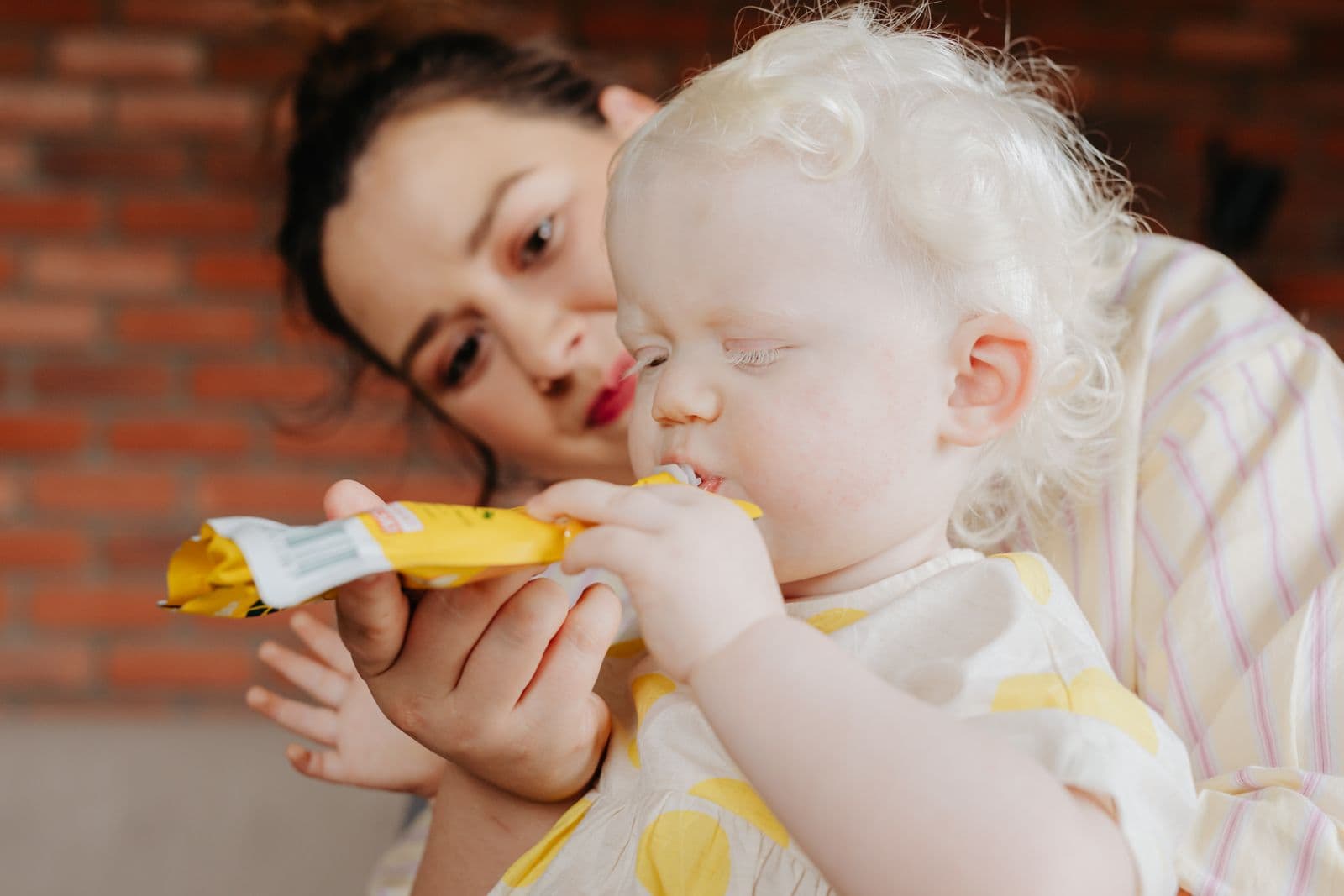
The DGKJ position statement recommends that infants and young children should not suck pureed or liquid foods from pouches. It gives three reasons. Sucking skips the practice with spoons, finger foods, chewing and new textures that the complementary feeding period exists to build. A child sucking a pouch alone loses the back-and-forth of responsive feeding, where a parent reads hunger and fullness cues. And sweet puree held against the teeth for a long time raises the risk of dental caries. Its conclusion is direct: pureed foods should be fed with a spoon, not sucked from the pouch.
The AAP's guidance points the same way without naming pouches. Its starting-solids page describes the goal of early feeding as getting used to sitting up, taking food from a spoon, resting between bites and stopping when full. A pouch emptied through the spout in one go skips most of that list.
What the data shows about how pouches are really used
The best data on actual use comes from New Zealand. A 2024 study in Nutrients by McLean and colleagues followed 933 children aged six months to almost four years. Most infants had eaten from a pouch at least once by about eight months. About 27 percent of infants were frequent users, at five or more pouches a week, falling to 16 percent of toddlers and 8 percent of preschoolers.
The detail that matters is the spout. Fewer than one in five infants took pouch food mostly or always straight from the nozzle, but about three in four toddlers and preschoolers did. Supervision moved the other way: 87.1 percent of caregivers always supervised an infant eating from a pouch, against 34.3 percent for toddlers and 14.9 percent for preschoolers.
The study did not find what the strongest warnings predict. Frequent pouch use was not linked to higher energy intake or a different BMI z-score in any age group, and the authors conclude their results do not support the strongest concerns. It is an observational study with small numbers in the older groups, and it did not measure teeth or feeding skills. So it narrows the concern rather than closing it. The pattern it does show is the one to manage: the older the child, the more the pouch becomes an unsupervised straw.
A short set of rules for using pouches well
None of the sources asks parents to give up pouches. They ask for a pouch to be used like a jar that travels well.
- Squeeze it onto a spoon or into a bowl. This is the DGKJ's core recommendation, and it keeps the spoon practice the AAP describes. It also leaves the rest of the pouch untouched, which matters for storage (below).
- Keep it a seated, supervised food. Pouch time belongs at the table or in the high chair, the same rule that applies to cups, which is set out with the injury data in sippy cup, straw cup or open cup.
- Rotate by first ingredient, not by flavor name. Read the back of the pack, and do not let one base vegetable or rice dominate a week.
- Make vegetables and protein the default pouch, fruit the side. Look for juice concentrate in the ingredients, whatever the front says about added sugar.
- Keep textures moving forward. A pouch is a puree. The DGKJ points to observational work linking late introduction of lumpy foods, after about nine to ten months, with later feeding difficulties. Finger foods and mashed table food should arrive on schedule, pouches or not. What a baby-led approach does to iron and choking risk is covered in the baby-led weaning trial guide.
Opened pouches: the storage rules
The USDA's WIC infant feeding food safety guide gives the checks for commercial baby food in any container:
- At purchase: buy clean, intact containers, and discard any dented or stained on the outside. For plastic pouches specifically, discard any that are swelling or leaking. For jars, the safety button on the lid should be down.
- Once opened: serve right away, or refrigerate and use within 48 hours, and within 24 hours for infant food meats.
- No freezing of jarred infant foods.
- Serve from a bowl, not straight from the container.
That last rule is where the spout creates a storage problem. A child sucking from the nozzle is being fed straight from the container, which is exactly what the guide's serve-from-a-bowl rule exists to avoid. Squeezing a portion into a bowl is what keeps the rest of the pouch inside the 48-hour refrigerator window, and a pouch that has been sucked from is best treated as finished.
Reusable pouches
Reusable pouches let a parent fill a spout with homemade puree. In the New Zealand study, 8.7 percent of infants were frequent users of a reusable or home-filled pouch. The same rules apply to what goes in: homemade food is not exempt from the variety advice, and the AAP makes that point directly. The cleaning is harder. A narrow spout and a sealed bottom seam are the same problem as a bottle nipple or a straw. The CDC's guidance for infant feeding items is to separate every part and scrub each piece with a brush kept only for feeding items, and a pouch whose seams a brush cannot reach does not meet it. The routine is in do you need a bottle sterilizer.
For the gear that does make the move to self-feeding easier, the feeding roundup at the best feeding gear covers bowls, spoons and cups for the starting-solids stage.
Questions people actually ask
Are baby food pouches safe?
The food inside is held to the same FDA lead action levels as a jar: 10 parts per billion for most fruits, vegetables and mixtures, and 20 for single-ingredient root vegetables and dry infant cereals. The main concern from pediatric groups is the spout, not the container: the German Society for Pediatrics and Adolescent Medicine recommends feeding pouch food from a spoon rather than letting a child suck it.
Do pouches have more sugar than jars?
Often, because most pouches are fruit-based. A 2015 US analysis found two-thirds of pouches were fruit or fruit-and-vegetable products, and that pouches in several categories were more likely than jars to contain added sugar such as juice concentrate. A no-sugar-added label does not mean low in sugar.
How long does an opened baby food pouch last?
The USDA's WIC food safety guide says to refrigerate opened commercial baby food and use it within 48 hours, or 24 hours for infant food meats. The same guide says to serve from a bowl rather than the container, so squeeze out a portion and refrigerate the rest.
Should I throw out pouches because of the lead news?
The FDA says parents should not throw out packaged baby foods or stop feeding certain foods because of its action levels. It recommends variety across food groups instead. The exception is a recalled product, which should be discarded, with a call to the pediatrician if a child ate it.
Do pouches cause overeating or weight gain?
A 2024 New Zealand study of 933 children found no link between frequent pouch use and higher energy intake or BMI. It was observational and did not look at teeth or feeding skills, which are the other concerns pediatric groups raise.
Sources
- FDA, Guidance for Industry: Action Levels for Lead in Processed Food Intended for Babies and Young Children
- FDA, Constituent Update: FDA Issues Final Guidance for Industry on Action Levels for Lead in Processed Food Intended for Babies and Young Children
- FDA, Investigation of Elevated Lead and Chromium Levels: Cinnamon Applesauce Pouches
- American Academy of Pediatrics, HealthyChildren.org, Heavy Metals in Baby Food: Reducing Risk of Exposure
- American Academy of Pediatrics, HealthyChildren.org, Starting Solid Foods
- Koletzko B, Bührer C, Ensenauer R, et al. Complementary foods in baby food pouches: position statement from the Nutrition Commission of the German Society for Pediatrics and Adolescent Medicine (DGKJ). Molecular and Cellular Pediatrics, 2019, 6(1), 2
- Beauregard JL, Bates M, Cogswell ME, Nelson JM, Hamner HC. Nutrient Content of Squeeze Pouch Foods for Infants and Toddlers Sold in the United States in 2015. Nutrients, 2019, 11(7), 1689
- McLean NH, Bruckner BR, Heath AM, et al. Frequent Use of Baby Food Pouches in Infants and Young Children and Associations with Energy Intake and BMI: An Observational Study. Nutrients, 2024, 16(18), 3165
- CDC, How to Clean, Sanitize, and Store Infant Feeding Items
- USDA WIC Works, Infant Feeding Food Safety Job Aid
As an Amazon Associate we earn from qualifying purchases. We earn a commission on some links, at no extra cost to you. It never changes which products we recommend or the order they appear in. Full disclosure

Who wrote this
Writer, standards and the recall record
Dan Whitfield writes the standards side of BabyGearSearch: what a certification actually covers, what the CPSC recall database says about a brand, and what the one-star reviews agree on six months in. He is not a clinician and does not write as one. His job is to read the standard rather than the marketing page, quote the real number, and name the limit the packaging skipped.
More from DanThe standard
How this guide was built
- Manufacturer specification sheets and warranty terms, read in full rather than summarised from a listing.
- The federal safety standard the product is certified to, plus anything NHTSA, the AAP or the CPSC has published on it.
- Owner reports at volume, including the one-star reviews, which is where failure modes live.
- Every price checked against the live listing on the date printed beside it.