The Best Audio Baby Monitors, Judged on How They Wake You
Four audio-only monitors from $23.95 to $69.99, ranked on alert style, talk-back, battery and how many rooms they cover. No camera, no app, no Wi-Fi.
- Writer, standards and the recall record
- Oct 19, 2026
- 13 min read
4 products compared
In this guide
An audio monitor does one job. It carries the sound of one room into another, and it tells you when that sound gets loud. Everything else on the box, from the night light to the lullabies, is trim around that single function.
That narrowness is the reason to buy one. A sound-only unit costs a fraction of a video monitor, sets up in the time it takes to plug it in, and has no account, no app and no router in the path. Plenty of parents find that a cry is the only signal they ever act on at 3am, and a picture adds a screen to check without changing what they do next.
So the four picks below are judged on the part that actually fails at night: how the parent unit gets your attention. A unit that only plays sound through a speaker is useless with a fan running or a partner asleep. A unit with a light bar, a vibration alert or a talk-back button changes how you respond, and that is where the price differences come from.
What separates one audio monitor from another
Sound quality is no longer the dividing line. All four picks run on DECT, the digital cordless standard that in North America sits in the 1920-1930 MHz band the FCC set aside for unlicensed cordless devices, clear of the 2.4GHz and 5GHz bands a home Wi-Fi network crowds. A DECT link pairs the parent unit to its baby unit digitally, which is why the hiss and the stray neighbor's signal of the old analog monitors are gone. The full case for and against that radio, room by room, is in Wi-Fi versus DECT baby monitors.
With the link itself roughly equal, four things decide which unit suits a household.
How it alerts you. A sound-level light bar lets you read the room with the volume down. A vibration alert lets the parent unit sit in a pocket or on a pillow and buzz without making noise. Only one pick here has that second feature.
Whether you can talk back. Two-way talk turns the parent unit into an intercom, so a parent can settle a waking toddler from the hallway. It matters less for a newborn and more as the child grows.
What runs on a battery. On some units only the parent end has a battery and the baby unit needs a wall outlet. On others both halves are rechargeable, which is what makes a monitor practical in a hotel room or at a grandparent's house.
Range, read honestly. Every box quotes an open-field figure of 1,000 or 1,500 feet. Indoors that number collapses. VTech's own DM221 manual lists an indoor range of about 160 feet, and BabyGearLab's range trial of that unit kept a signal through six interior walls before it dropped. If the nursery is at the far end of a house with plaster or brick between the rooms, read monitor range in a house with thick walls before deciding a longer quoted range will fix it.
The picks
$36.95
Price checked Oct 19, 2026
VTech DM221 Audio Baby Monitor
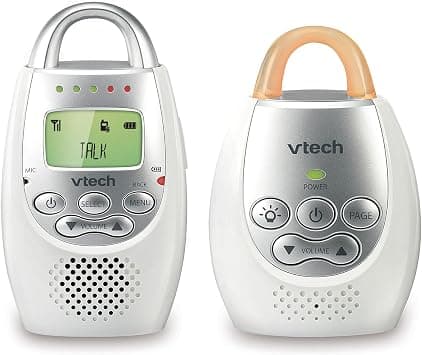
The DM221 is the only monitor here with a vibrating sound alert, which makes it the right choice for anyone who sleeps beside a fan, a white noise machine or a partner who should stay asleep. It pairs that with a talk-back intercom and a night light on the baby unit that can be switched from the parent end. VTech quotes up to 18 hours on the parent unit's rechargeable battery and 1,000 feet of open-field range, with about 160 feet listed for indoor use. The baby unit has no battery and runs from its adapter, so it stays put. It is wrong for a family that wants to carry the whole kit to a hotel, because only one half of it travels.
We may earn a commission on this link. It never changes the ranking.
- Type
- Audio only, 1 parent + 1 baby unit
- Connectivity
- DECT 6.0, no Wi-Fi
- Alerts
- Sound lights, vibration
- Talk-back
- Yes
- Quoted range
- 1,000 ft open field, about 160 ft indoors
What works
- Vibrating sound alert, the only one in this roundup
- Talk-back intercom to settle a child from another room
- Rechargeable parent unit with a belt clip
- Night light on the baby unit, controlled from the parent end
What to know
- Baby unit needs a wall outlet at all times
- One parent unit in this set
- Indoor range is a fraction of the 1,000-foot box figure
$23.95
Price checked Oct 19, 2026
VTech DM111 Audio Baby Monitor
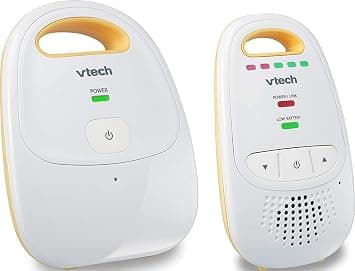
The DM111 is the category stripped to its frame. It carries sound over DECT 6.0, shows volume on a five-level sound indicator, clips to a belt, and runs up to 8 hours on the parent unit's battery, with a quoted range of 1,000 feet. There is no talk-back, no night light and no vibration, so the only way it reaches you is through its speaker and its lights. That is enough for a quiet house and a parent who wakes to a cry. It is wrong for anyone who sleeps through sound or keeps a fan on, because without a vibration alert a noisy bedroom can mask the one signal the unit sends.
We may earn a commission on this link. It never changes the ranking.
- Type
- Audio only, 1 parent + 1 baby unit
- Connectivity
- DECT 6.0, no Wi-Fi
- Alerts
- 5-level sound indicator
- Battery
- Up to 8 hours, parent unit
- Quoted range
- 1,000 ft
What works
- Lowest price of the four by a wide margin
- Five-level sound indicator lets you read the room with the volume down
- Belt clip and battery let the parent unit move around the house
- No app, account or router involved
What to know
- No talk-back intercom
- No vibration alert, so a loud bedroom can drown it out
- 8-hour battery will not cover a long night plus the next day off the charger
$49.99
Price checked Oct 19, 2026
Motorola Nursery PIP12 Audio Baby Monitor
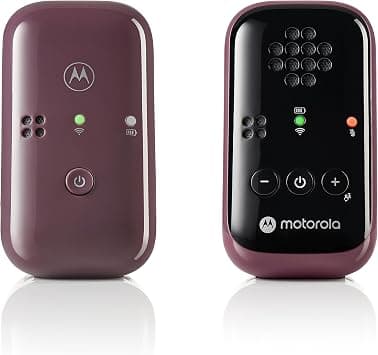
The PIP12 is built to leave the house. Both the parent unit and the baby unit take rechargeable AAA cells and charge over USB-C, so neither one needs to sit near an outlet, and the set ships with a water-resistant travel case. Staples' specification sheet puts the battery at up to 10 hours and the open-field range at 1,500 feet, with two-way talk on a press-and-hold button. Its price matches the $49.99 Kohl's lists for the same set. It is wrong as a permanent nightstand monitor for a light sleeper, because it has no vibration alert and a battery-powered baby unit has to be remembered on the charger.
We may earn a commission on this link. It never changes the ranking.
- Type
- Audio only, 1 parent + 1 baby unit
- Connectivity
- DECT, no Wi-Fi
- Power
- Rechargeable AAA in both units, USB-C
- Talk-back
- Yes
- Quoted range
- 1,500 ft open field
What works
- Both units are rechargeable, so the baby unit can sit anywhere
- USB-C charging and a water-resistant travel case in the box
- Two-way talk
- Longest quoted range of the single-room picks, 1,500 ft
What to know
- No vibration alert
- Two batteries to keep charged instead of one
- No room temperature reading, unlike the PIP15
$69.99
Price checked Oct 19, 2026
Motorola Nursery PIP15 Dual Room Audio Baby Monitor (2 baby units)
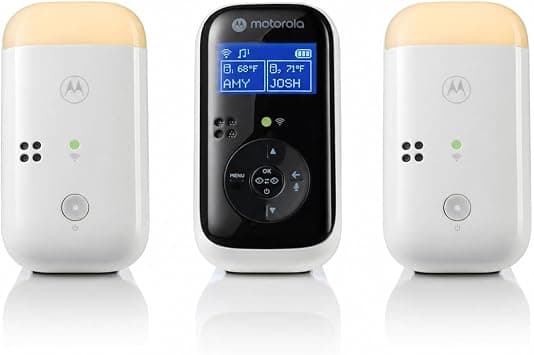
This is the PIP15 set with one parent unit and two baby units, the only pick here that covers two rooms out of the box. Motorola's PIP15 page lists a backlit 1.5-inch display, wideband audio, a room temperature reading, two-way talk, a night light with preloaded lullabies, up to 9 hours on rechargeable batteries with USB-C charging, and support for up to four baby units. The open-field range is quoted at 1,500 feet. Its $69.99 price matches what Walmart lists for the same two-unit set. It is wrong for a single nursery, because the second baby unit is money spent on a room nobody sleeps in, and the single-unit PIP12 covers the rest of the job for $20 less.
We may earn a commission on this link. It never changes the ranking.
- Type
- Audio only, 1 parent + 2 baby units
- Connectivity
- DECT, no Wi-Fi
- Display
- 1.5-inch backlit, with room temperature
- Battery
- Up to 9 hours, USB-C
- Quoted range
- 1,500 ft open field
What works
- Two baby units in the set, one parent unit
- Room temperature shown on the parent unit display
- Expandable to four baby units
- Rechargeable, USB-C, two-way talk and night light
What to know
- No vibration alert
- Pays for a second room a one-child home does not need
- Small 1.5-inch display is for status, not reading
The comparison, in one table
| Monitor | Price | Baby units | Vibration alert | Talk-back | Quoted range |
|---|---|---|---|---|---|
| VTech DM221 | $36.95 | 1 | Yes | Yes | 1,000 ft |
| VTech DM111 | $23.95 | 1 | No | No | 1,000 ft |
| Motorola PIP12 | $49.99 | 1 | No | Yes | 1,500 ft |
| Motorola PIP15 Dual Room | $69.99 | 2 | No | Yes | 1,500 ft |
Who each one is wrong for
The VTech DM221 is wrong for travel. Its baby unit has no battery, so it needs an outlet within reach of where the child sleeps, and in a hotel room that outlet is often beside the crib. That placement is exactly where a cord should not be.
Skip the DM111 if you are a heavy sleeper. Its only signals are sound and a row of lights, and a parent who sleeps through a cry will sleep through both. For a light sleeper in a quiet room, though, it covers the core job for under $25.
The Motorola PIP12 suits the opposite case to the DM221. It is weakest as an everyday bedroom monitor for a parent who needs a silent alert, and strongest as a second set that lives in a bag for weekends away.
Buying the PIP15 Dual Room for a single nursery is paying for hardware you will not use. For siblings in separate rooms, or a newborn plus a toddler, it is the simplest way to hear both on one unit, and two separate single-room sets would leave you with two parent units to carry and charge.
Which one to buy
For most households choosing an audio monitor as the main monitor, the VTech DM221 is the default. The vibration alert solves the most common failure of this category, a parent unit that cannot be heard over the bedroom, and the talk-back covers the toddler years.
If the budget is the deciding line and the house is quiet at night, the DM111 does the essential part for about two-thirds of the price.
If the monitor has to travel, the PIP12 is the one pick where neither half depends on a wall outlet.
If two rooms need covering, the PIP15 Dual Room is built for that and nothing else here is.
For a camera view as well as sound without bringing Wi-Fi into it, the DECT baby monitor roundup covers the video side of the same radio, and the main baby monitor roundup covers the connected cameras.
Placing an audio monitor safely
The device with the cord is the baby unit, and on two of these picks it lives on a plug-in adapter full time. The Consumer Product Safety Commission has warned for years that children have been strangled by baby monitor cords, and its guidance is to keep the monitor and its cord at least 3 feet from the crib. That figure applies to an audio unit exactly as it does to a camera. Put the baby unit on a dresser or shelf across the room, run the cord away from the crib, and check it again whenever the crib moves. The full placement walk-through, including what to do in a small room, is in baby monitor cord safety and placement.
Questions people actually ask
Is an audio-only baby monitor enough?
For many families, yes. A cry is the signal most parents act on at night, and an audio unit carries it reliably for a fraction of the cost of video. If you want to glance at the crib before deciding whether to get up, a video unit adds that, and the DECT roundup covers the no-Wi-Fi options.
Can an audio baby monitor be picked up by neighbors?
The old analog monitors could be overheard on the same frequency. All four picks here use DECT, a digital link that pairs the parent unit to its own baby unit, which closes that gap. None of them connects to the internet, so there is no account or app for anyone to get into.
Why does an audio monitor lose signal inside the house when the box says 1,000 feet?
Box range figures are measured in open air with nothing in between. Walls, floors, plaster, brick and appliances all cut into it, and VTech's own DM221 manual lists about 160 feet for indoor use. Moving the baby unit higher or to a different wall of the nursery often helps more than buying a longer-range model.
Do I need a vibration alert?
Only if sound might not wake you. A parent who sleeps with a fan or white noise on, wears earplugs, or shares a bed with a partner who needs to sleep through the night gets the most from it. In a quiet room, the sound and the light bar are usually enough.
How far from the crib should an audio monitor go?
At least 3 feet, cord included, which is the CPSC's guidance for every baby monitor. Put the baby unit on a dresser or shelf and run its cord away from the crib, never along the rail.
Sources
- CPSC: Baby monitor cords, keep them 3 feet from baby
- CPSC recall list
- American Academy of Pediatrics, HealthyChildren.org: A parent's guide to safe sleep
- FCC Order 10-77, on the 1920-1930 MHz UPCS band and DECT
- Motorola Nursery: PIP15 audio baby monitor specifications
- Staples: Motorola PIP12 specifications
- BabyGearLab: VTech DM221 review, including the manual's indoor range figure
As an Amazon Associate we earn from qualifying purchases. We earn a commission on some links, at no extra cost to you. It never changes which products we recommend or the order they appear in. Full disclosure

Who wrote this
Writer, standards and the recall record
Dan Whitfield writes the standards side of BabyGearSearch: what a certification actually covers, what the CPSC recall database says about a brand, and what the one-star reviews agree on six months in. He is not a clinician and does not write as one. His job is to read the standard rather than the marketing page, quote the real number, and name the limit the packaging skipped.
More from DanThe standard
How this guide was built
- Manufacturer specification sheets and warranty terms, read in full rather than summarised from a listing.
- The federal safety standard the product is certified to, plus anything NHTSA, the AAP or the CPSC has published on it.
- Owner reports at volume, including the one-star reviews, which is where failure modes live.
- Every price checked against the live listing on the date printed beside it.